
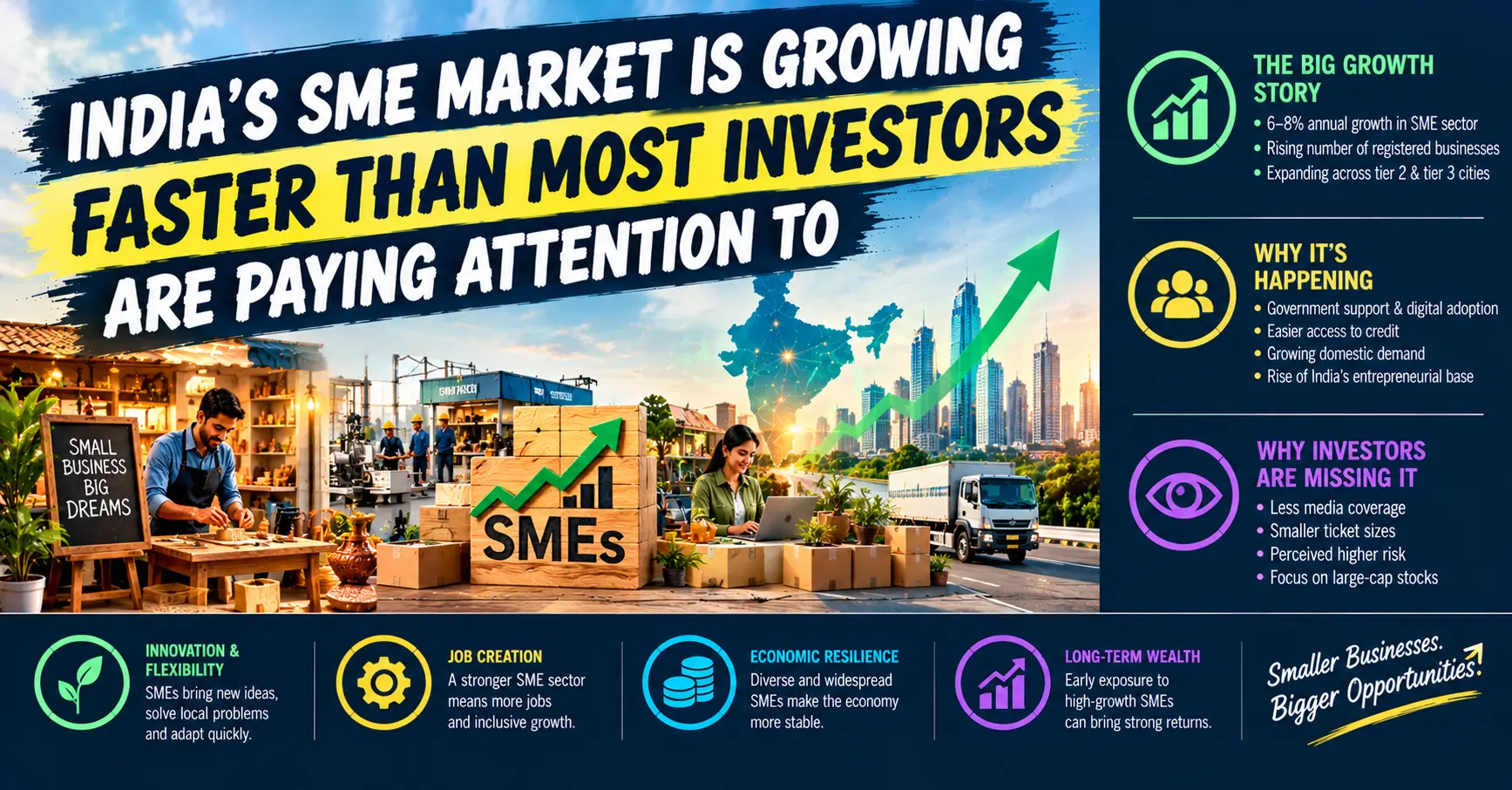
When investors talk about the Indian stock market, they usually mean big firms, the Nifty 50, bank shares, and big tech. But another aspect of the Indian stock market is gaining interest: SME (small and medium enterprises).
SME businesses include firms in sectors such as manufacturing, engineering, chemicals, textiles, healthcare, and industrial services. As India’s economy grows, SMEs have become an important part of investment talks.
But while a growing business can be one thing, making it a good investment is quite another matter.
Why India’s SME Market Is Attracting Attention
Small businesses play an important role in the Indian economy. They provide employment, supply to manufacturers, cater to local needs, and contribute to exports.
With refined infrastructure, manufacturing, logistics, and technological advancements, the increased demand can help small suppliers grow their production, customer base, and geographic presence.
This would open doors to SMEs who have good management, good products, and the ability to grow.
It is not just the technological start-ups that have a story to grow. Other traditional companies like those dealing with auto parts, industrial equipment, packaging, food processing, and specialized manufacturing can also benefit from India’s growing industry.
The Numbers Show Why SMEs Matter
As per the Economic Survey 2025-26, MSMEs in India generate nearly 31.1% of the GDP, 35.4% of the manufacturing output, and 48.58% of exports. The sector accounts for over 38.9 crore jobs.
Further, the stock market is also helping small businesses. As per the SEBI bulletin of February 2026, till January 31, 2026, there have been 232 SME IPOs that have raised approximately ₹10,500 crore.
These funds could be used for expanding their manufacturing units, investing in technology, hiring manpower, etc. For investors, such financing could mean an opportunity to invest in companies before they become popular.
Government Support Could Create New Opportunities
Government programs that assist the manufacturing sector, infrastructure, exports, and small businesses could create demand for small companies. An instance is the establishment by the Union Cabinet of a Small Business Growth Fund worth ₹10,000 crores in October 2026 to be used as an equity investment in order to enable these firms to grow.
The companies utilizing this aid may become more productive and competitive. But just because the firm is being assisted by the government does not mean that the firm will perform well.
Why Investors Need to Be Careful
The SME segment presents itself with opportunities for growth but is not without risks that must not be overlooked.
Smaller firms lack an extensive track record of operations, have limited clients, and less financial flexibility compared to larger companies. The shares of some SMEs might be thinly traded, meaning it will be hard to obtain or offload the shares at a desired price.
The valuation is another important factor. While a firm may generate impressive revenues, its stock price might be relatively high because the markets are already valuing the company based on anticipated profits for years to come. Investors should analyze earnings, cash flows, debt position, promoter information, client dependence, and other factors before buying.
Moreover, SEBI has stepped up its oversight of the SME sector.
Conclusion
The Indian SME stock market needs to be considered equally important for economic growth because of its significance in manufacturing, exports, employment generation, and overall growth. With proper access to finance and favorable policies, some of these firms have the potential to become larger enterprises in the future.
However, not all SME stocks represent undervalued investment opportunities. Instead, the emphasis needs to be placed on searching for financially healthy enterprises with competent management and high demand.
For a more detailed analysis on the Indian stock market, join Strategic Alpha’s “The Conviction Club”. A membership program for stock market enthusiasts.
FAQs
What is the SME market in India and how is it different from the main stock exchange?
The SME market helps small and medium enterprises raise capital through listing and selling shares to the public for business expansion. The SME market is not like the regular stock market; there are different listing criteria and characteristics. There could be less trading volume and greater risks in investing in SME stocks.
How do I invest in SME stocks in India as a retail investor?
You can buy SME stocks through a stockbroker licensed to deal with SME stocks. Create your Demat and trading account and study the business and financial standing of the enterprise before buying stocks. Know more about the trading conditions and minimum lot size of SME stocks.
Are SME stocks in India safe for beginners to invest in?
SME stocks can be riskier because smaller firms may lack capital, have a small number of clients, and have less liquidity.
If you need guidance on how to start your stock market journey, how much capital is enough to begin with, how to do smart investing, or how to take informed stock market decisions, you can join Strategic Alpha’s ‘The Conviction Club’. This is a membership program, especially curated to help investors become aware and knowledgeable about stock market trends, news, and technical aspects, so that they can become their own experts.
Our YouTube channel, weekly webinars, and digital resources available on the website can help you learn the basics of the stock market. For regular updates on trends, one-to-one sessions with experts, and detailed learning modules, you can join the Conviction Club, which is the online community of like-minded investors sharing knowledge and thoughts to grow together.
Subscribe to the Strategic Alpha Newsletter now to get the latest updates about weekly webinars.
Join Me On My Telegram Channel Where I Share Much More Value Adding Knowledge Of Investing/ Trading: Click Here
Also, Don’t Forget To Follow Us On Our Social Media Accounts:
Facebook: https://www.facebook.com/strategicalpha/
Instagram: https://www.instagram.com/strategicalpha/
Twitter: https://twitter.com/suyog_dhavan
YouTube: https://bit.ly/2IIqztO
Disclaimer: Strategic Alpha and Suyog Dhavan are not SEBI-registered investment advisor. The content provided is purely for educational purposes and should not be construed as financial or investment advice. Viewers are encouraged to conduct their own research or consult with a SEBI-registered professional before making any investment decisions.