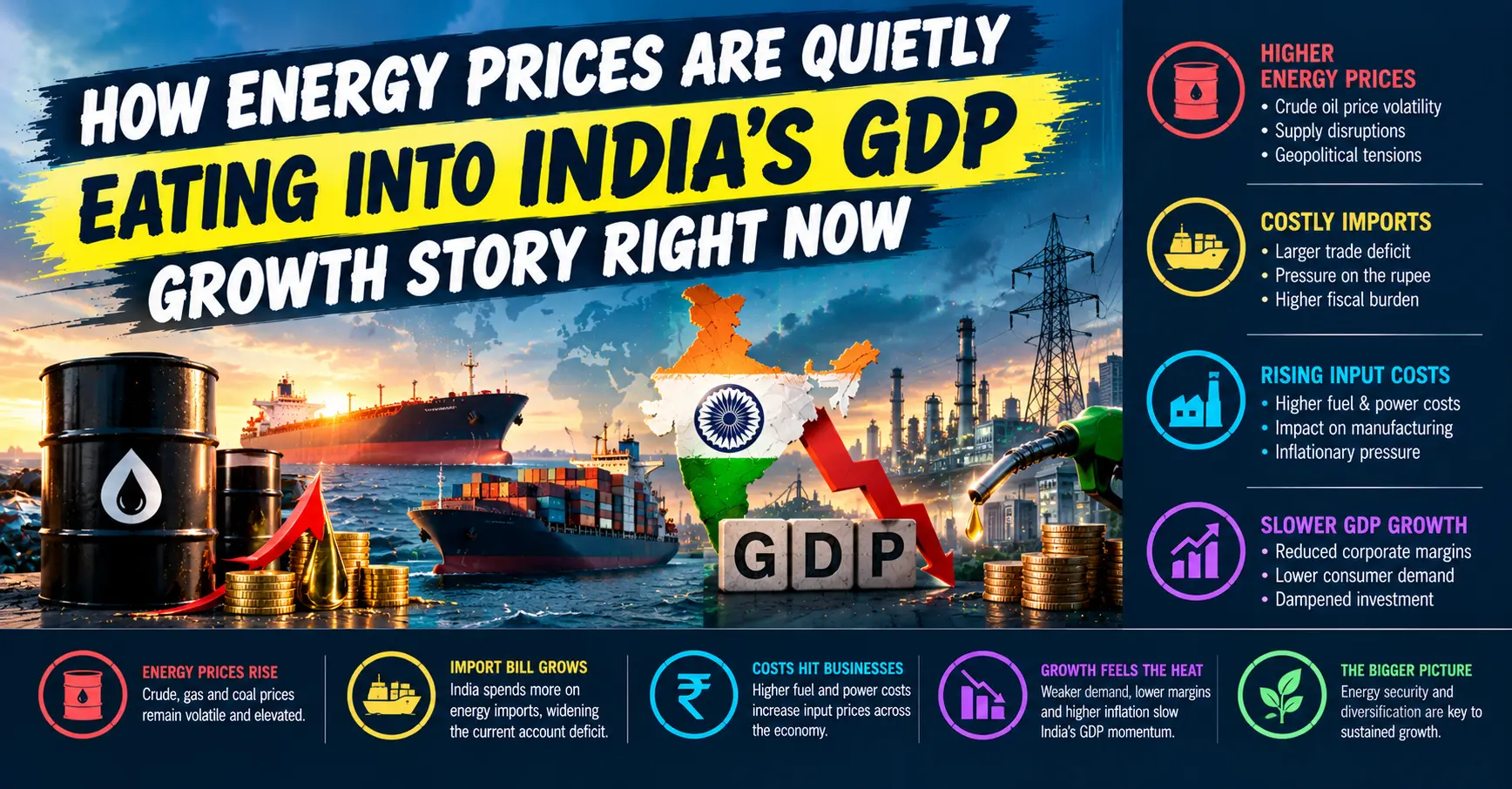
India’s economy has posted strong growth, with GDP rising 7.8% in the first quarter of FY 2026-27. The manufacturing and services sectors have contributed significantly to the economy, indicating resilient domestic activity. However, a serious problem is emerging with rising energy prices.
India depends on crude oil for a large share of its energy needs, so its economy is vulnerable to global energy prices.
Why Energy Prices Matter So Much for India
Oil is a critical input in almost every sector of the economy. Firms require fuel to move raw materials and goods, while firms require energy to manufacture.
High energy prices increase operating costs. Some firms bear the cost; hence, they become less profitable. On the other hand, some firms may transfer the cost to consumers through high prices.
This becomes a problem because high costs reduce firm profitability, whereas high prices affect household expenditure.
India is highly dependent on foreign energy sources. The IMF has previously warned that India is highly vulnerable to oil shocks due to its high dependency on foreign oil sources.
The Pressure on Inflation
Another important issue related to the high energy cost is inflation. Increased costs in the form of fuel and transport can slowly push up prices. Higher input costs in fertilizers and other inputs could cause higher prices in food.
The significance of this issue is that inflation will decrease the purchasing power of individuals. With more spending on fuel, food, and other necessities, people will be left with less money to buy cars, electronic gadgets, and so on.
It will eventually impact the economy as a whole.
Why Strong GDP Growth Can Still Face Pressure
The current growth rate of 7.8% indicates that the Indian economy is performing well. However, this growth in the economy is measured in terms of activity that took place in a time period that has already gone by. Energy costs could affect the forecast for the quarters.
This is the reason why the economy being robust at present doesn’t imply that the pace will be sustained.
The finance ministry itself has pointed out that higher costs of oil, along with uncertainties in the global economic environment, have put pressure on the forecast.
The RBI Has Another Problem to Solve
A rise in energy prices will also complicate matters for the Reserve Bank of India. It should support growth and at the same time keep inflation within reasonable limits. However, when energy prices result in inflation, there may not be much leeway for cutting interest rates.
Indeed, on October 7, the RBI increased the repo rate to 5.5 percent and took a calibrated tightening approach owing to inflationary pressures coupled with growth.
An increase in interest rates can make borrowing expensive and ultimately lead to reduced investment and real estate activity.
What Does This Mean for the Stock Market?
Energy prices impact various sectors differently. Oil marketers, airlines, transport firms, chemicals, and many other energy-intensive industries could experience margin compression if costs increase. At the same time, some energy producers and those who have the ability to set their own prices might be in a more advantageous position.
The bottom line for investors is that higher oil prices do not impact all firms the same way.
Besides the GDP growth figures, investors should pay attention to the impact of energy costs on margins and consumer demand.
Can India Absorb the Shock?
Several positive factors exist for India. Internal demand, industry, and investment can act as support even under unfavorable external conditions.
Another favorable factor is that India is gradually moving towards alternative energy, which will improve energy security in the long term.
Nevertheless, high energy prices for a long time will be more difficult for India to endure. The OECD has pointed out that high energy prices will have negative effects on private consumption and investments.
Final Thoughts
The Indian 7.8% GDP growth rate is no doubt a very clear signal, but energy prices will test the sustainability of such momentum in a low-profile way.
Should oil prices stay high, the consequences will go beyond fuel prices and will influence corporate costs, consumer spending, price levels, and even interest rates.
This means that, for investors, it is not about focusing on India’s GDP growth rate alone. It is rather about sustaining the momentum when energy costs are high.
In other words, India’s economic story is still good, but the cost of fueling that story cannot be overlooked.
FAQs
How do rising energy prices affect India’s GDP growth directly?
Higher energy costs will mean higher costs of doing business, transportation, and production. Companies will record lower profits, and consumers will have to pay more for fuel and necessities. They will have little left over for other expenditures. In the long run, lower consumer spending, investments, and business activities may lower GDP growth.
Why does India’s economy struggle more than others when crude oil prices rise?
India imports a lot of its crude oil and, therefore, any increases in the international oil price will lead to increased import expenditure in the country. This will affect the rupee exchange rate and the rate of inflation in the country. In addition, it will be costly for the companies to transport and produce their products.
How much of India’s GDP growth can be offset by high energy prices?
There is no way to tell how much GDP growth in India will be affected by high energy prices. This will depend on how high energy prices go and how long this will continue. It is possible that the effect will be minimal in the short run, but the longer the shock lasts, the more it will affect consumption, investments, and economic activity.
Which sectors get hurt the most when energy prices rise in India?
Energy-intensive industries will be among the first to experience the pressure. Airlines, transportation, chemicals, manufacturing, logistics, and construction industries are some of those that will likely have higher operational expenses. There might be industries that will not be able to pass these increased expenses to consumers and, therefore, will experience lower profit margins.
If you need guidance on how to start your stock market journey, how much capital is enough to begin with, how to do smart investing, or how to take informed stock market decisions, you can join Strategic Alpha’s ‘The Conviction Club’. This is a membership program, especially curated to help investors become aware and knowledgeable about stock market trends, news, and technical aspects, so that they can become their own experts.
Our YouTube channel, weekly webinars, and digital resources available on the website can help you learn the basics of the stock market. For regular updates on trends, one-to-one sessions with experts, and detailed learning modules, you can join the Conviction Club, which is the online community of like-minded investors sharing knowledge and thoughts to grow together.
Subscribe to the Strategic Alpha Newsletter now to get the latest updates about weekly webinars.
Join Me On My Telegram Channel Where I Share Much More Value Adding Knowledge Of Investing/ Trading: Click Here
Also, Don’t Forget To Follow Us On Our Social Media Accounts:
Facebook: https://www.facebook.com/strategicalpha/
Instagram: https://www.instagram.com/strategicalpha/
Twitter: https://twitter.com/suyog_dhavan
YouTube: https://bit.ly/2IIqztO
Disclaimer: Strategic Alpha and Suyog Dhavan are not SEBI-registered investment advisor. The content provided is purely for educational purposes and should not be construed as financial or investment advice. Viewers are encouraged to conduct their own research or consult with a SEBI-registered professional before making any investment decisions.