

Precision Engineering: Where Accuracy Creates Value
1. Understanding Precision Engineering
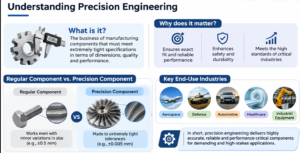
Precision Engineering is the process of producing parts that have very precise dimensions. In other words, precision engineering is not simply producing parts; it is ensuring they have the right dimensions and qualities to perform their specific functions.
For instance, a metal part may function even if its dimensions are slightly off. But a part in an aircraft engine, satellite, or medical device needs to be produced with extreme precision, as any error could affect its performance or safety.
That is why precision engineering is very important in industries such as aerospace, defense, automotive, health care, and machinery.
2. Manufacturing vs. Precision Engineering
Manufacturing is the broader activity, while precision engineering is a specialised part of it.
While traditional manufacturing centers on producing goods or their parts at the required cost, quality, and scale, precision engineering places its focus on a very high level of accuracy, unique processes, and quality standards.
The major distinction lies in the complexity of work performed. Manufacturing an ordinary metal part might be rather easy, while manufacturing a special part for airplane engines or defense systems requires advanced equipment and professional engineers with numerous quality controls.
All of these factors could serve as entry barriers for competitors. Nevertheless, the possibility of charging extra fees and getting better margins will depend on the complexity of the part, customers’ demands, competition, and the company’s cost structure.
3. The Value Chain: Where Are the Margins?
The precision engineering value chain can broadly be understood through four stages:
- Raw materials: Metals and other specialised materials are sourced to manufacture components.
- Component manufacturing: Companies use machining, fabrication and other processes to convert raw materials into usable parts.
- Precision engineering and specialised processing: Components requiring greater accuracy, complex designs or specialised manufacturing capabilities are produced and tested.
- Assembly and system integration: Multiple components are combined into a finished assembly or system that meets the customer’s requirements.
The economics can differ significantly across these stages. Basic manufacturing may face greater price competition, while specialised components can offer stronger pricing power when few suppliers possess the necessary capabilities or customer approvals.
However, higher complexity does not automatically mean higher profitability. Margins also depend on production volumes, machinery costs, employee expertise, rejection rates, customer bargaining power and capacity utilisation.
For investors, the important question is whether a company possesses specialised capabilities that customers find difficult to replace—and whether those capabilities translate into sustainable returns.
Global & Domestic Industry Tailwinds
Structural Tailwinds Driving India’s Precision Engineering Industry
Tailwind 1: Global Aerospace and Defence OEMs are Diversifying Their Supplier Base
Global aerospace and defence manufacturers are increasingly looking for alternative suppliers to diversify their supply chains and improve cost competitiveness. Air travel reached approximately 5.2 billion passengers in 2025, while the global commercial aircraft backlog stood at around 17,000 aircraft, equivalent to more than 12 years of production visibility at prevailing delivery rates. The global commercial fleet is expected to increase from approximately 30,000 aircraft in 2026 to 41,000 by 2036, implying a CAGR of around 3.2%. This provides a long-duration demand opportunity for aerospace manufacturers and their component suppliers as aircraft OEMs gradually increase production to address the backlog. Indian manufacturers can benefit from this shift, with cost advantages of approximately 20–30% over international competitors. Qualification for certain energy components can take 36–48 months, creating high entry barriers and potentially long-standing customer relationships once suppliers are approved.
Tailwind 2: India’s Defence Manufacturing Ecosystem is Expanding
India’s push towards domestic defence production under Atmanirbhar Bharat is creating demand for precision-engineered components used in aircraft, missiles, radar systems and naval platforms. Defence production reached approximately ₹1.51 lakh crore in FY25, up 18% YoY, while defence exports increased 12.04% to a record ₹23,622 crore. Additionally, India’s target of achieving ₹50,000 crore in defence exports by FY29, alongside global military modernisation, provides an opportunity for domestic precision manufacturers to expand beyond Indian customers and enter global defence supply chains. Within the domestic market, aerospace, defence and industrial machinery are projected to grow at approximately 13%, 11.4% and 12.5% CAGR, respectively, between FY24 and FY29.
Tailwind 3: Global precision-engineered goods are benefiting from multiple structural drivers.
Beyond aerospace, demand is expanding across semiconductors, medical devices, energy and power, supported by technological advancement, automation and increasingly stringent manufacturing requirements. The global market is expected to grow at approximately 9.9% CAGR between CY25 and CY28. This broad-based demand creates opportunities for manufacturers with the technical capabilities and customer qualifications required to supply high-precision components across multiple industries.
Tailwind 4: India is emerging as a competitive manufacturing destination.
The Indian precision-engineered goods market is expected to grow from approximately US6.5billioninFY24toUS11.6 billion by FY29, implying a CAGR of around 11.6%. Government-led manufacturing initiatives, cost competitiveness, skilled engineering talent and the China+1 strategy are supporting India’s integration into global supply chains. This creates an opportunity for domestic manufacturers to move beyond basic outsourcing towards higher-value and more complex manufacturing.
Tailwind 5: Automotive Premiumisation, Electrification and Lightweighting
The automotive industry continues to demand increasingly sophisticated components, driven by vehicle premiumisation, tighter performance requirements and lightweighting. The transition towards EVs and hybrids is creating opportunities for specialised components, including aluminium-based products designed to reduce vehicle weight and improve efficiency. Additionally, China+1 sourcing and supply-chain diversification are encouraging OEMs to explore alternative manufacturing locations. Companies with advanced machining, aluminium manufacturing and technology-agnostic component capabilities can potentially benefit across both conventional and electric vehicle platforms.
2. The Most Important Question: Where Are the Margins Highest?
A common misconception is that all precision engineering companies enjoy high margins simply because they manufacture sophisticated components.
The profitability of a precision engineering company depends heavily on what it manufactures, how difficult the product is to replicate, how many qualified suppliers exist and how much bargaining power the company has with its customers.
Let’s examine the available numbers.
Automotive components: Scale, but significant pricing pressure
The automotive component industry generally operates with relatively competitive margins.
According to ICRA’s FY2026 outlook, the Indian auto-component industry’s operating profit margins were expected to moderate to approximately 10.5–11.5% in FY2026. (ICRA)
Why can margins be relatively constrained?
- Large vehicle manufacturers negotiate aggressively with suppliers.
- Many standard components can be manufactured by multiple suppliers.
- Steel, aluminium, employee expenses and energy are significant costs.
- Suppliers may not be able to pass on cost increases to customers immediately.
This does not mean that all automotive suppliers earn low margins. Companies manufacturing complex components, proprietary products or specialised lightweight components can perform better.
For example, Sansera Engineering reported a consolidated EBITDA margin of 17.1% in FY2025, demonstrating that a precision-engineered component manufacturer with strong technical capabilities can earn margins above the broader auto-component industry benchmark.
Aerospace and defence: Potential for higher margins
Aerospace and defence can be more attractive because specialised components require extensive testing, technical expertise and customer approvals.
In some cases, the number of qualified suppliers is limited. This can improve a supplier’s negotiating position, although the actual pricing power varies by product and customer.
The Sansera Engineering states that aerospace exports carried margins approximately 6–8 percentage points higher than the company’s other business, while also noting that aerospace EBITDA margins of around 25% were possible. These are observations and expectations reported in the forum discussion, not independently verified industry-wide averages.
Azad Engineering provides another example of the potential profitability of specialised manufacturing.
Its FY2025 annual report records adjusted EBITDA of approximately ₹164.6 crore on revenue of ₹452.9 crore, implying an adjusted EBITDA margin of roughly 36.3%. The company’s reported FY2025 EBITDA margin was approximately 35.5%. (Azad Engineering)
Energy turbines and specialised industrial components: Another attractive segment
Gas turbines and other specialised energy equipment require components that operate under demanding conditions.
For example, turbine airfoils and blades must be manufactured to precise specifications because their shape and quality affect performance and reliability.
These requirements create technical barriers that can protect qualified suppliers from competition.
Azad Engineering’s FY2025 financial disclosures demonstrate that specialised turbine-component manufacturing can support high consolidated margins. However, the company does not provide a directly comparable, publicly reported EBITDA margin for every individual product category in the figures cited here. (Azad Engineering)
Therefore, it would be inappropriate to conclude that all turbine suppliers earn margins similar to Azad’s.
The more defensible thesis is that specialised energy components can offer attractive economics when the manufacturer possesses difficult-to-replicate capabilities and established customer relationships.
Margin Comparison: What the Numbers Actually Tell Us
| Segment / company | EBITDA | What it tells investors |
| Sansera Engineering | 17.1% in FY2025 | A precision-component manufacturer can outperform the broader auto-component benchmark |
| MTAR Technologies | Approximately 17.9% in FY2025 | Specialised engineering can be profitable, but margins remain sensitive to execution and capacity utilisation |
| Azad Engineering | Approximately 35.5% reported EBITDA margin in FY2025 | Certain specialised manufacturing businesses can achieve substantially higher margins |
Sources: ICRA, Sansera Engineering, MTAR Technologies and Azad Engineering.
The Structural Advantage: Why Existing Suppliers Can Be Difficult to Replace
One of the strongest points is the importance of customer qualification.
In conventional manufacturing, a customer may be able to switch suppliers relatively easily if another manufacturer offers a lower price.
In aerospace, defence and specialised energy applications, changing suppliers can require additional validation, testing and approvals.
Azad Engineering’s notes that qualification for some products can take 30–48 months. It also highlights the role of long-term contracts, customer relationships and the difficulty of reproducing established manufacturing capabilities.
This can create three advantages:
- Customer stickiness: Once a supplier is approved and consistently delivers quality products, the customer may have less incentive to replace it.
- Long-term revenue visibility: Long-term contracts and repeat orders can provide greater visibility than businesses dependent entirely on spot demand.
- Expansion opportunities: Once a supplier has established trust with a customer, it may have an opportunity to supply additional products or enter new programmes.
These advantages are particularly valuable when a company can expand its product range without compromising quality or profitability.
Azad Engineering
Azad Engineering: From Energy Components to High-Value Aerospace and Defence Manufacturing
1. Understanding Azad Engineering’s Business
Azad Engineering manufactures highly specialised, precision-engineered components for applications where even a minor manufacturing defect can affect the performance, reliability or safety of an entire system.
Its business spans three principal verticals:
- Energy: Precision components for gas, steam, thermal and nuclear turbines used in power generation.
- Oil & Gas: High-specification components for equipment used in the oil and gas industry.
- Aerospace & Defence: Complex components for aircraft engines, defence applications and propulsion systems.
Unlike conventional component manufacturers, Azad specialises in complex parts that require advanced machining, specialised materials and stringent quality controls. Its customers include global industrial and energy equipment manufacturers, which must qualify suppliers before integrating their components into critical equipment.
An important distinction on profitability: Azad reports a blended company-wide EBITDA margin rather than separately disclosing the EBITDA margins of its Energy, Oil & Gas and Aerospace & Defence businesses. Therefore, the company’s 35–37% overall margin cannot be attributed entirely to any one segment.
2. How Azad’s Business Mix Has Evolved
Azad’s historical strength has been its Energy business. Over time, the company has been expanding its presence in Aerospace & Defence while continuing to grow its core Energy business.
The revenue numbers illustrate this transition.
Revenue and Segment Mix
FY24: Azad generated standalone revenue of ₹340.8 crore. Energy & Oil & Gas contributed ₹284.6 crore, representing 83.5% of revenue, while Aerospace & Defence contributed ₹43.9 crore, or 12.9%.
FY25: Revenue increased to ₹452.9 crore, representing approximately 33% year-on-year growth. Energy & Oil & Gas revenue rose to ₹358.6 crore, while Aerospace & Defence revenue increased to ₹80.7 crore. The latter’s share of revenue expanded to 17.8%.
FY26: Revenue grew further to ₹590.4 crore, an increase of approximately 30% year-on-year. Energy & Oil & Gas revenue reached ₹481.1 crore, while Aerospace & Defence revenue increased to ₹101.3 crore. Aerospace & Defence crossed ₹100 crore in annual revenue for the first time, contributing 17.2% of total revenue.
Over FY24–FY26, standalone revenue increased approximately 73%, from ₹340.8 crore to ₹590.4 crore.
Energy & Oil & Gas continues to account for the majority of revenue, but Aerospace & Defence is becoming a more meaningful contributor to contribute the 35%–40% (or up to 40%–45%) of total revenue by 2029 .
By 2030 (FY30): Driven by their sustained 25% to 30%+ annual revenue CAGR guidance management aims to scale total annual revenue to ₹1,800–₹2,000 Cr by 2030 (up from ~₹590 Cr in FY26)
3. Why Can Azad Generate Such High EBITDA Margins?
Azad’s consolidated EBITDA margin reached 36.9% in FY26, compared with 35.5% on a standalone basis in FY25. Its profitability is supported by several structural characteristics of its business.
Robust order book exceeding ₹6,500+ Cr, providing multi-year revenue visibility.
High Product Complexity
Azad manufactures specialised turbine airfoils and other complex components that require advanced multi-axis machining, precision manufacturing and stringent quality control.
These are not interchangeable, mass-produced components. Their technical complexity and critical applications create barriers to entry and support higher value addition.
In-House Special Processes
Azad has invested in bringing important manufacturing processes in-house, reducing its dependence on external vendors.
This helps the company exercise greater control over quality, turnaround time and manufacturing costs.
Operating Leverage
Azad is expanding its manufacturing capacity through dedicated facilities for major customers. As these facilities ramp up production, a larger volume of output can absorb fixed manufacturing overheads more efficiently.
This creates the potential for better operating leverage.
4. Capacity Expansion: Building for the Next Phase of Growth
Azad’s growth strategy is supported by a substantial expansion of its manufacturing footprint.
Historically, the company operated from its manufacturing base in Jeedimetla, Hyderabad. Its established manufacturing footprint eventually grew to approximately 20,000 square metres.
In 2021, Azad secured land for its expansion at Tuniki Bollaram Industrial Park. The new campus was subsequently developed to accommodate customer-specific manufacturing facilities and additional capabilities.
The expansion includes approximately 95,000 square metres under Phase 1, with a further approximately 67,000 square metres planned under Phase 2. These are planned expansion areas, not measures of fully operational production capacity.
The customer-dedicated facilities are intended to support specific manufacturing programmes:
- Mitsubishi Heavy Industries: Precision components for energy and gas turbine applications.
- GE Vernova: Complex rotating and stationary airfoils for steam power applications, including nuclear, industrial and thermal power turbines.
- Siemens Energy: Precision airfoils and critical components for gas, industrial and thermal turbine engines.
- Baker Hughes: Azad’s first dedicated facility in its Oil & Gas vertical, supporting the company’s commitments to Baker Hughes.
The MHI facility was inaugurated in March 2025, followed by GE Vernova in April 2025 and Siemens Energy in September 2025. The Baker Hughes facility was inaugurated in April 2026.
5. Backward Integration: Controlling More of the Manufacturing Process
Azad has also invested in backward integration to reduce external dependencies and improve control over its supply chain.
Its initiatives include:
- In-house forging: Developing forging capabilities to supply the machining operation with components closer to their required final shape.
- Dedicated feeder forging plant: Integrating forging capacity into the Tuniki Bollaram expansion to support downstream manufacturing.
- Heat treatment: Building internal capabilities for specialised processing of components.
- Acquisition of VTC Surface Technologies: Bringing additional specialised surface-treatment and coating capabilities into the group.
- Raw-material localisation: Working with domestic suppliers to qualify materials for applications previously dependent on imported or externally sourced inputs.
6. Financial Performance: FY24 to FY26
Azad’s recent financial performance demonstrates growth in both revenue and profitability.
| Metric | FY24 | FY25 | FY26 |
| Standalone revenue | ₹340.8 crore | ₹452.9 crore | ₹590.4 crore |
| Year-on-year revenue growth | — | 33% | 30% |
| Energy & Oil & Gas revenue | ₹284.6 crore | ₹358.6 crore | ₹481.1 crore |
| Energy & Oil & Gas share | 83.5% | 79.2% | 81.5% |
| Aerospace & Defence revenue | ₹43.9 crore | ₹80.7 crore | ₹101.3 crore |
| Aerospace & Defence share | 12.9% | 17.8% | 17.2% |
| Standalone EBITDA margin | 34.3% | 35.5% | 36.9% |
7. What Management Sees Ahead
Management’s stated outlook has centred on sustained revenue growth, the ramp-up of new manufacturing facilities and deeper relationships with existing global customers.
The key guidance and execution priorities are:
- Capacity utilisation: Ramp up the four recently inaugurated customer-dedicated facilities and commission additional facilities under development.
- Customer expansion: Increase business with existing customers while progressing through qualification processes for additional components and programmes.
- Aerospace & Defence: Continue scaling this business as component qualifications and customer programmes progress towards commercial production.
Future 2-Year Outlook, Order Book & Growth Guidance
| Metric / Parameter | Azad Engineering |
| Annual Growth Guidance | Reiterated target;25%–30% annual revenue CAGR. On track toward ₹1,800–₹2,000 Cr revenue by 2030. |
| EBITDA Margin Guidance | Sustainable target range of 33%–35% (frequently touching 37%–38%) |
| Order Book & Pipeline | Robust order book exceeding ₹6,500+ Cr, providing multi-year revenue visibility. |
| Key Future Growth Drivers | • H2 FY27 substantive revenue crystallization as dedicated OEM capacity ramps up.
• Surging data center power demand driving gas turbine airfoils • Defense small/missile engine project completion (75% complete) |
Key Risks Investors Should Understand
Customer concentration: Dependence on a few large customers can make revenue vulnerable if orders are delayed, reduced or cancelled.
Execution risk: Complex components require strict quality control. Manufacturing defects, failed inspections or delayed deliveries can increase costs and damage customer relationships.
Capacity utilisation: Advanced machinery and specialised facilities require substantial investment. If production volumes remain low, fixed costs can put pressure on margins.
Working capital: Companies may need to purchase raw materials and manufacture components well before receiving payment from customers. Rapid growth can therefore put pressure on cash flows.
sUnimech Aerospace
Unimech Aerospace: An Established Tooling Business with Multiple Growth Levers
Aerospace tooling: Already participating in the growth cycle
Unimech is already participating in the aerospace upcycle, with approximately 86% of its FY26 revenue coming from aerospace tooling. Its exposure to global engine OEMs, Tier-1 suppliers and MRO players positions the company across both new-engine production and aftermarket maintenance requirements. The business also has a five-year programme with FACC valued at approximately US$7.5 million, providing additional programme visibility.
Expanding qualified product portfolio
The company’s qualified product portfolio has expanded significantly, from 932 SKUs in FY22 to approximately 6,300 SKUs in FY26.
Precision Component Assemblies: The next growth engine
While aerospace tooling remains the company’s primary business, precision components currently contribute approximately 10% of FY26 revenue, providing a relatively small base from which this segment can scale. The platform includes machined components, metallic bellows, tubing, fixtures and engineered assemblies catering to aerospace, defence, semiconductors, nuclear, power and industrial applications.
The opportunity lies in moving beyond the supply of individual components towards sub-assemblies and integrated solutions. This can increase the value of each customer relationship and allow Unimech to participate in a wider portion of the manufacturing value chain. Growing outsourcing by global OEMs, supply-chain diversification and localisation requirements provide additional support for this expansion.
The company has also started building a presence in the nuclear segment, securing approximately ₹87 crore of orders for reactor repair and refurbishment, alongside participation in an EMCCR tender pipeline exceeding ₹400 crore.
Hobel acquisition: Moving towards higher-value assemblies
The acquisition of Hobel Bellows adds capabilities in metal forming, hydroforming, precision pipe fabrication, advanced welding, metallic bellows and engineered assemblies. These capabilities allow Unimech to expand beyond individual machined components into higher-value products and integrated manufacturing solutions.
Hobel reported approximately ₹129 crore in FY26 revenue, with EBITDA margins and ROCE both exceeding 50%. The acquisition broadens the company’s exposure to high-horsepower engines, locomotives, marine engines and power generation.
Saudi JV: Establishing a manufacturing presence in the Middle East
Unimech has entered into a 51:49 joint venture with the YBA Kanoo Group to establish a manufacturing platform in Dammam, Saudi Arabia. The venture is intended to address localisation-led opportunities across oil and gas, utilities and mining, combining Unimech’s precision-engineering capabilities with Kanoo’s regional customer relationships.
The project involves a planned investment of approximately US$30 million over three years. The initial equity tranche of SAR 30 million has been deployed, with 23 CNC machines planned for installation. Commercial production is targeted for March–April 2027.
Dheya: Expanding into specialised defence applications
Unimech has also invested in Dheya Engineering Technologies, with an initial 16% stake and a roadmap to increase its holding to 30%. The strategic arrangement provides exclusive manufacturing rights for indigenously developed micro-gas turbines and UAV electronic control units. This gives the company an entry point into specialised defence applications.
Capacity and Capital Expenditure: Preparing for the Next Phase
Unimech has undertaken a significant capacity expansion over the last few years. Its Bengaluru manufacturing operations have added more than 141 large machines, increasing installed machine-hour capacity from approximately 2.2 lakh hours to around 6.3–6.8 lakh hours. The expansion supports its existing aerospace tooling business as well as the scaling of precision components, nuclear programmes and semiconductor capital-equipment applications.
The company has also acquired Hobel’s approximately 2 lakh sq. ft. manufacturing facility in Visakhapatnam, adding specialised capabilities in metallic bellows, flexible tubing and exhaust assemblies. The acquisition was completed for approximately ₹450 crore. Rather than spending an estimated ₹100 crore on building similar capabilities organically over 18–24 months.
Further investments are directed towards strengthening the manufacturing ecosystem. In Bengaluru, Unimech is setting up in-house special-process and finishing capabilities, including robotic welding, seam welding, anodising, electroless nickel plating, passivation, heat treatment and surface finishing. These facilities are targeted for commissioning by December 2026, with Nadcap certification targeted by March 2027. Bringing these processes in-house can improve control over production timelines, quality and process traceability.
The company is also developing its Saudi manufacturing platform and expanding its manufacturing infrastructure in Bengaluru. At the same time, management has indicated that the immediate focus for domestic operations is shifting towards maintenance capex and better utilisation of recently installed machinery. Further large-scale capacity additions are expected to be considered as utilisation approaches 85–90%.
Capacity Utilisation: Operating Leverage from Existing Assets
Despite the significant expansion in manufacturing capacity, utilisation stood at approximately 52% in FY26, excluding the allocation for first-article inspection. This leaves meaningful headroom to increase production without requiring a proportionate increase in fixed assets.
As aerospace, precision-component and nuclear programmes move from qualification into serial production, Choice estimates utilisation could increase to approximately 65% in FY27, 73% in FY28 and 78% in FY29.
Management Commentary and Growth Guidance
Management’s commentary points towards a strategy focused on improving asset productivity while scaling the business across its existing and newly added capabilities. The key operating priorities include:
- Asset productivity: Management has indicated a long-term blended asset-turnover target of approximately 2.5x, highlighting the importance of generating higher revenue from the expanded manufacturing base.
- Order visibility: The consolidated order book stands at approximately ₹280 crore, providing a base for near-term execution across the company’s businesses.
Revenue and Margin Outlook
For FY27, management expects H2 revenue to exceed H1 revenue, with H1 FY27 revenue at approximately ₹230.6 crore. The expected improvement is supported by higher deliveries to semiconductor capital-goods customers, execution of nuclear orders, a full-quarter contribution from Hobel and continued activity in the core aerospace tooling business.
On profitability, the original FY27 consolidated EBITDA margin guidance was 34–35%. Following an H1 FY27 EBITDA margin of approximately 38% and Q2 FY27 margin of around 40%, management expressed confidence in maintaining similar margin levels in H2. These recent margins are above the original annual guidance and should be viewed in the context of the company’s evolving business mix and quarterly execution.
Over the medium term, management has articulated an aspiration to reach approximately ₹1,000 crore in revenue around FY29. The company is also targeting sustainable EBITDA margins of approximately 35%, supported by higher capacity utilisation and operating leverage. Long-term PAT margins are expected to remain in the range of 20–25%.
The Saudi JV has a separate ambition of reaching approximately US$30 million in revenue by its fifth year of operation. For acquired and synergy-driven businesses such as Hobel, management has indicated a relatively conservative growth assumption of 15–20% over the next three to four years.
Transformers
What a Transformer Does and Why It Matters
A transformer is the quiet workhorse of any power grid: a static machine that steps voltage up for long-distance transmission and steps it down for end use, with no moving parts and no practical substitute. Electricity generated at 11–33 kV cannot be moved economically over hundreds of kilometres; a step-up transformer raises it to 220–765 kV to reduce losses, while step-down transformers return it to usable levels at the consumption end.
Every solar farm, data centre, and new industrial load therefore requires transformers at both ends of the wire. A transformer has three core components:
- Magnetic core: Made from CRGO (cold-rolled grain-oriented) electrical steel, which carries the magnetic flux.
- Copper windings: Precision conductors that carry the current.
- Insulation system: Oil, paper, or resin that prevents high-voltage arcing.
For investors, the key distinction is between:
| Segment | Characteristics | Investment implication |
| Distribution transformers | Standardised, competitive, lower-margin | More commoditised, weaker pricing power |
| Large power transformers | Custom-engineered, type-tested, utility-approved | Higher entry barriers, stronger pricing power |
The higher the voltage class, the fewer the qualified suppliers—and the greater the pricing power.
The Outlook: A Demand-Secure Supercycle Constrained by Supply
The global transformer market is expected to grow from roughly USD 65 billion in 2025 to USD 88 billion by 2030. The defining feature of this cycle is that demand is not the limiting factor—the supply chain is.
Four simultaneous demand drivers
- India’s renewable build-out: India added a record 55 GW of renewable capacity in FY26. Each gigawatt requires transformer infrastructure at pooling substations and evacuation points. Green Energy Corridor Phase 3 alone represents a ₹23,500 crore order opportunity.
- Grid replacement in developed markets: North America and Europe face an ageing-grid replacement cycle. US replacement demand is expected to open up from 2027 onward, while few domestic suppliers remain—creating a large export window for Indian manufacturers.
- AI data centres: Data centres have emerged as a third demand stream alongside utilities and industrials, and are explicitly cited by leading manufacturers as a growth driver.
- PGCIL capex: Power Grid Corporation’s grid-upgradation investment is expected to double over the next four to five years, including a 33.25 GW HVDC pipeline.
Why supply is the bottleneck
| Constraint | Impact |
| Long lead times | Transmission-scale transformer lead times are 18–24 months in India and 3–6 years in the US |
| Capacity limits | Higher-voltage manufacturers are running at or near full capacity |
| CRGO steel dependence | India imports 100% of transformer-grade CRGO from Japan, China, Russia, and Europe; CRGO is 33–35% of raw-material cost |
| Critical components | High-voltage bushings, CTC, and on-load tap changers come from a small number of qualified global suppliers |
| Testing and approvals | Utility qualification takes years and restricts new entrants |
The strategic response that separates winners from the rest is backward integration. Control over CRGO, bushings, CTC, and testing converts a full order book into sustained margin.
Preferred Pick 1: TARIL The Integrated Transmission Leader
Transformers & Rectifiers India (TARIL) is the premier domestic transmission-scale player, manufacturing up to 765 kV and 1,200 kV class units. It is expanding capacity from over 75,000 MVA to 82,000 MVA to meet India’s project timelines.
Commercial position
- Order book: ₹7,240 crore, approximately 2.6x trailing sales
- Tender pipeline: ₹21,000 crore
- FY26 revenue: ₹2,509 crore, up 24.2%
- FY26 operating margin: 15.3%
- ROCE: 21%
- Valuation: 30.7x P/E, with a 0.36 PEG, near the peer median despite superior scale
Management notes that full order books are keeping pricing power stable, even in lowest-bidder state tenders.
The key differentiator: backward integration
TARIL’s most important structural initiative is a five-facility backward-integration programme covering:
- CTC
- Pressboard
- RIP bushings
- Fabrication
- CRGO processing
These facilities are targeted to be fully operational by Q1 FY28, supported by a long-term mother-coil supply contract for CRGO.
Management expects:
- 200–300 bps of incremental EBITDA margin
- Gross margin improvement from 30–32% toward 35% by FY28
- Around 60% of components to become captive
Key risk
FY26 operating cash flow was negative at ₹105 crore due to heavy working-capital requirements. The margin-improvement thesis depends on all five plants commissioning on schedule.
Preferred Pick 2: Supreme Power Equipment The Agile Small-Cap Climbing the Voltage Ladder
Supreme Power Equipment is a smaller, faster-scaling specialist that has spent three decades moving up the voltage ladder—from distribution transformers to 200 MVA, 220 kV power transformers. It operates two plants in Tamil Nadu with a combined annual capacity of 9,000 MVA.
Business model
The company follows a custom-engineered, build-to-order model, selling directly to:
- State utilities
- EPC contractors
- Industrial buyers
Its order book stood at ₹588 crore as of May 2026, plus roughly ₹160 crore at its 90%-owned subsidiary, Danya Electric.
Positioning and growth
- Power transformers account for 72% of the product mix
- Inverter-duty transformers rose from 7% to about 18% of revenue in FY25
- Nearly 40% of the order book is solar-linked
- FY26 revenue grew 22.1% to ₹182 crore
- FY26 operating margin: 18.1%
- ROCE: 19.4%
- OCF/PAT: 125%, reflecting strong cash conversion
- Valuation: 26x P/E, below the peer median
The company deliberately caps utility exposure at 40–50% of revenue, with private buyers contributing nearly three-quarters of FY25 revenue—helping limit receivables risk.
Key risk
At ₹261 crore of total assets, Supreme Power is still a niche player. Its move into higher-voltage, higher-margin categories must be funded and qualified step by step.
Investment Comparison
| Factor | TARIL | Supreme Power Equipment |
| Positioning | Large transmission-scale leader | Small-cap climbing the voltage ladder |
| Voltage capability | Up to 765 kV / 1,200 kV class | Up to 220 Kv |
| Order book | ₹7,240 crore | ₹588 crore, plus ₹160 crore at subsidiary |
| FY26 revenue | ₹2,509 crore | ₹182 crore |
| FY26 OPM | 15.3% | 18.1% |
| ROCE | 21% | 19.4% |
| Valuation | 30.7x P/E | 26x P/E |
| Main advantage | Backward integration and scale | Cash flow quality and customer diversification |
| Main risk | Working capital and execution | Limited scale and qualification requirements |
If you need guidance on how to start your stock market journey, how much capital is enough to begin with, how to do smart investing, or how to take informed stock market decisions, you can join Strategic Alpha’s ‘The Conviction Club’. This is a membership program, especially curated to help investors become aware and knowledgeable about stock market trends, news, and technical aspects, so that they can become their own experts.
Our YouTube channel, weekly webinars, and digital resources available on the website can help you learn the basics of the stock market. For regular updates on trends, one-to-one sessions with experts, and detailed learning modules, you can join the Conviction Club, which is the online community of like-minded investors sharing knowledge and thoughts to grow together.
Subscribe to the Strategic Alpha Newsletter now to get the latest updates about weekly webinars.
Join Me On My Telegram Channel Where I Share Much More Value Adding Knowledge Of Investing/ Trading: Click Here
Also, Don’t Forget To Follow Us On Our Social Media Accounts:
Facebook: https://www.facebook.com/strategicalpha/
Instagram: https://www.instagram.com/strategicalpha/
Twitter: https://twitter.com/suyog_dhavan
YouTube: https://bit.ly/2IIqztO
Disclaimer: Strategic Alpha and Suyog Dhavan are not SEBI-registered investment advisor. The content provided is purely for educational purposes and should not be construed as financial or investment advice. Viewers are encouraged to conduct their own research or consult with a SEBI-registered professional before making any investment decisions.