
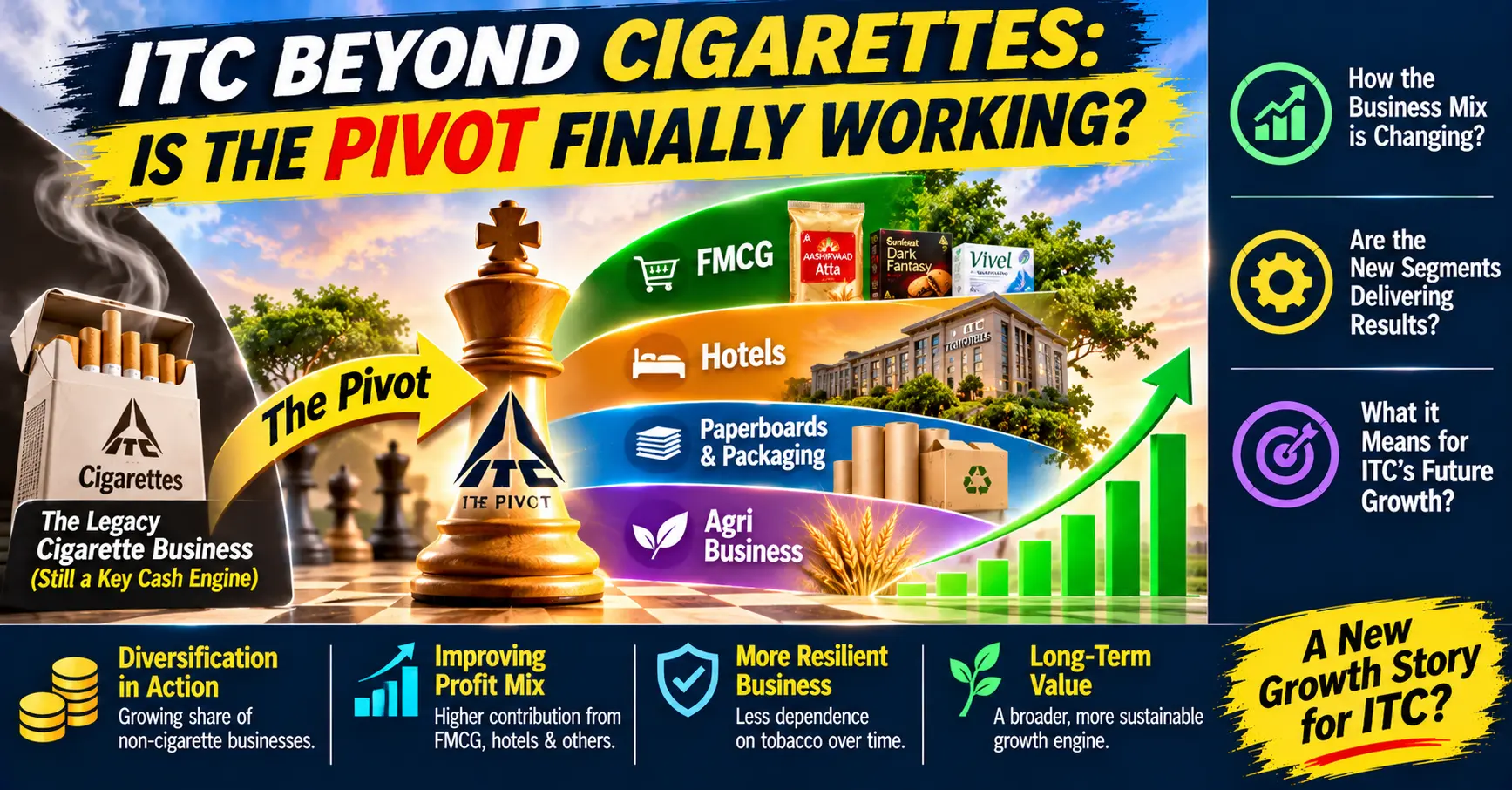
For over two decades, ITC has tried to shrink its dependence on cigarettes. This piece follows that effort from the problem to the proof to the stress test, and asks one question: is the shift reliable enough to matter?
THE CASH COW PARADOX
ITC greets every Indian every morning, even if they don’t smoke a cigarette. Chapatis are rolled out using Aashirvaad atta, Sunfeast biscuits are packed in Classmate bags, hands are washed using Savlon, and Mangaldeep agarbattis are lit. It would seem that there is nothing left to do for the erstwhile Imperial Tobacco Company of India to complete the great reinvention job of corporate India – from a colonial tobacco company to an omnipresent brand reaching 70 lakh retail outlets.
The profit and Loss statement proves the story is quite the opposite. Over two decades, ITC has spent tens of thousands of crores on FMCG, hotels, paperboards and agribusiness to depend on tobacco. However, until the tax shock, cigarettes brought over 80% of operating profits, which financed precisely the diversification that was supposed to substitute them.
Segment-wise Revenue Trends from FY21-FY26*
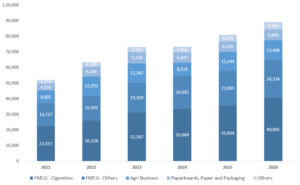
*The figures above are obtained from the Annual Report 2025-26 and state the external segment-wise revenue, and therefore exclude the intersegment revenue.
The numbers behind the paradox
Revenue versus profit: In FY26 the businesses beyond cigarettes (FMCG Others at ₹24,315 crore, Agri at ₹20,787 crore and Paperboards & Packaging at ₹8,769 crore) generated ₹53,871 crore, or ~54% of gross segment revenue. Yet cigarettes delivered ₹22,245 crore of the ₹27,066 crore total segment results in FY26, and ₹21,091 crore of ₹25,775 crore in FY25. That is a profit share of over 80%.
Two very different margins: FMCG Others has grown from zero in 2001 to over ₹37,000 crore of consumer spend in FY26, but against entrenched rivals it earns segment EBITDA margins of about 10% (10.4% in Q2 FY27 vs 9.9% in Q2 FY26). Cigarettes, protected by a ban on tobacco advertising that locks out new entrants, give ITC about 77% to 78% of the legal market. In FY26 they delivered a segment PBIT margin of 54.8% on gross revenue.
The vulnerability: A single policy decision can shake the whole company. From February 1, 2026, the government replaced the GST compensation cess on cigarettes with a steep rise in Central Excise Duty and GST. In Q2 FY27 (quarter ended September 2026), net cigarette revenue fell 21% year on year and cigarette PBIT fell 27.2%, a drop of ₹1,428 crore to ₹3,813 crore. The non tobacco gains of ₹263 crore in combined segment PBIT could barely cushion the blow, and standalone net profit fell 20.1% YoY to ₹4,137 crore.
This sets up the question that has divided Dalal Street for twenty years: is ITC’s transformation finally reaching an inflection point, or is the cigarette cash cow simply too big for the rest of the business to ever catch up?
THE LEGACY ENGINE: WHY CIGARETTES ARE BOTH THE STRENGTH AND THE TRAP
If you designed a business in a laboratory to maximise return on capital, it would look a lot like ITC’s cigarette division. It is a near oligopoly selling a habit-forming, low-ticket product that needs very little new capital to grow. But the traits that make it such a powerful financial machine also make it a structural trap.
The fortress
The economics begin with a regulatory moat. The Cigarettes and Other Tobacco Products Act (COTPA) of 2003 bans all tobacco advertising in India. The law was meant to curb consumption, but it also shut out new entrants, who cannot run commercials or build brand awareness. Behind that barrier, Gold Flake, Classic and Wills Navy Cut hold roughly 77% to 78% of the legal market. With mass media off limits, the contest is won at the shop counter, and the distribution network ITC built there, funds itself and later became a free launchpad for its FMCG products.
Look at the capital efficiency on ITC’s Consolidated Financial Statements for FY25 and FY26. At the end of FY25 (as of March 31, 2025), the Cigarettes segment held ₹10,585 crore in Segment Assets against ₹5,730 crore in Segment Liabilities, translating to a net segment capital employed of just ₹4,855 crore (which rose to ₹8,246 crore in FY26 on ₹13,996 crore of assets and ₹5,750 crore of liabilities, primarily due to leaf tobacco inventory build-up and tax transitions). On that modest capital base, Cigarettes generated a result of ₹21,091 crore in FY25 and ₹22,245 crore in FY26; delivering a staggering segment return on capital employed of +255%.
The trap
The dependence is uncomfortable because of a sharp asymmetry. According to the Tobacco Institute of India (TII) and company disclosures, legal cigarettes account for less than 10% of India’s tobacco consumption by weight, yet they contribute roughly 80% of the government’s tobacco tax revenue. Whenever public finances are tight, legal cigarettes take the hit.
February 2026 showed how hard that hit can land. The government abolished the GST compensation cess, raised GST on cigarettes from 28% to 40%, and introduced excise duties that rise with cigarette length, from ₹2,050 to ₹8,500 per 1,000 sticks, on top of the existing NCCD levy. Tax per stick rose by 20% to 40%, taking total taxes to 65% to 80% of the retail price.
Pricing power has a ceiling, and illicit cigarettes sit just above it. Cigarettes that evade tax already equal roughly one third of the legal market’s volume and, according to ITC’s FY26 disclosures, cost the exchequer an estimated ₹23,000 crore a year. They are ready to absorb smokers who trade down.
Tax is not the only pressure. India requires graphic health warnings on 85% of both sides of a cigarette pack, among the strictest norms in the world. The global shift to ESG investing has also shrunk the pool of capital that can own the stock: many sovereign wealth funds and pension managers screen out tobacco entirely, and foreign institutional investor (FII) ownership in ITC fell by more than 350 basis points between March 2023 and mid 2025.
With the cash cow under steady pressure, the mandate for management was clear. The businesses beyond tobacco could no longer be side projects. They had to become giants in their own right.
THE PIVOT PLAYBOOK: HOW ITC PLANNED THE EXIT FROM DEPENDENCE
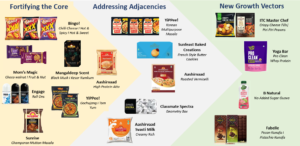
ITC’s exit strategy was never a bet on unrelated businesses. It reused what cigarettes had already built: farm sourcing, packaging, supply chains and retail reach. From 2001, management set out to build three pillars beyond tobacco, which are FMCG Others, Agri Business, and Paperboards, Paper & Packaging, and to deal with the capital heavy Hotels business along the way. The direction has stayed the same for over two decades, even when the size of cigarette profits made progress look slow.
FMCG: brands built from scratch
The centrepiece is FMCG Others, covering staples, snacks, personal care, stationery and homecare. ITC invested in 12 integrated manufacturing and logistics facilities and built household names from the ground up: Aashirvaad in staples, Sunfeast and Bingo! in snacks, YiPPee! in noodles, Classmate in notebooks, Mangaldeep in agarbattis, and Savlon and Fiama in personal wash. Standalone FMCG Others revenue reached ₹24,210 crore in FY26, up 10.1%.
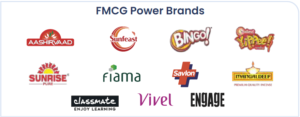
Since 2021, ITC has added acquisitions in new categories, usually starting with a minority stake and moving to control once a brand proves itself:
- Mother Sparsh (baby and personal care): entered in 2021, stake raised to 49.3% in April 2025 for ₹81 crore.
- Yoga Bar (via Sproutlife Foods): 39.4% in May 2023 for ₹175 crore, 44.7% in March 2024 for ₹50 crore, majority control in April 2026, and full ownership on September 28, 2026.
- Prasuma (via Ample Foods, frozen and chilled foods): 43.8% for ₹131 crore in early 2025, with a path to 100% by 2028.
- 24 Mantra Organic (via Sresta Natural Bioproducts): ITC’s only upfront full buyout in FMCG, for ₹472.5 crore in June 2025.
By Q2 FY27, this digital first and new brand portfolio was growing over 70% YoY and had crossed an annual revenue run rate of ₹1,800 crore.
Agri and Paper: from support units to growth engines
Agri Business began as a leaf tobacco sourcing arm. It now sources nearly 40 lakh tonnes across more than 20 crops, feeding ITC’s own food brands while growing exports. Through its ITCMAARS farming platform, it has leaned toward higher margin value added products such as spices, coffee, frozen marine products and processed fruits, and its nicotine and derivatives subsidiary, ITC IndiVision, has been PBIT positive for three straight quarters through Q2 FY27. Agri revenue grew from ₹15,791 crore in FY24 to ₹20,787 crore in FY26, with PBIT steady at about ₹1,500 crore.

Paperboards began by supplying cartons for cigarettes and has grown into value added paperboards and sustainable packaging. Even through a cyclical downturn, ITC chose to expand, completing the 100% buyout of Century Pulp and Paper on August 1, 2026 for ₹3,498 crore, far larger than any FMCG deal above.

 Hotels: freeing the balance sheet
Hotels was the clearest drag on capital. When the demerger was announced in July 2023, the business absorbed about 20% of ITC’s capital employed while contributing under 3% of segment EBIT. ITC handled it in two steps. In 2018, it moved to an asset right model, growing by managing properties owned by developers instead of funding construction, so that managed properties make up 55% of its room inventory, with a target of 65% by 2030. Then, once cash flows steadied after the pandemic, ITC demerged Hotels into a separately listed ITC Hotels Limited, effective January 1, 2025.
Funded by the cash cow
All of this was paid for by cigarette cash. ITC paid ₹14.50 per share in dividends for FY26, about ₹18,168 crore in total (₹6.50 interim and ₹8.00 final). The playbook never had to choose between investing and rewarding shareholders.
Plans are one thing. The harder question is why, for so many years, the numbers did not seem to move.
THE EARLY YEARS: WHY THE SHIFT LOOKED STUCK
For much of two decades, ITC’s diversification looked like a treadmill. Annual reports celebrated new launches, bigger factories and wider reach, yet every time investors checked the profit mix, it barely moved. The market’s skepticism was not blindness to the effort. It came from the hard arithmetic of building thin margin, capital hungry businesses next to a cash cow.
Built from scratch, built slowly
When ITC entered FMCG in 2001, it chose to build brands and factories itself instead of buying scale. That meant launching many categories at once, each needing years of heavy brand spending and trade discounts to win shelf space, along with large investment in supply chain assets. ITC’s own segment disclosures long noted that FMCG results carried significant business development, brand building and gestation costs. As late as FY17, the segment’s EBITDA margin was just 2.5%.
That weight still shows. After depreciation on those manufacturing investments, FMCG Others earns a PBIT margin of only 7.19% in FY25 and 7.45% in FY26, compared with EBITDA margins close to 10%.
The brutal arithmetic
Cigarettes earned a PBIT margin of 72.2% on net revenue in FY25. At roughly 7% for FMCG, that means the new business needed about ten times the revenue to match the operating profit that cigarettes made on every rupee of net sales. The target also kept moving: whenever tax conditions were stable, legal cigarettes kept growing, lifting segment PBIT from ₹20,025 crore in FY25 to ₹21,051 crore in FY26.
Why the doubt lasted
To shareholders, the picture was consistent for years. High return tobacco cash flows seemed to subsidise a low return hotels portfolio, while Agri and Paper stayed exposed to commodity cycles and cost shocks. A conglomerate had spent two decades and thousands of crores on capex, and yet it remained over 80% dependent on cigarette profits. It was a fair question: would the non tobacco engine ever be big and profitable enough to carry ITC on its own? The data now gives a more interesting answer.
THE INFLECTION: WHAT IS PANNING OUT NOW
Look closely at the data and the shift is real, but it shows up in one place before another. It is clearest in the quality of the FMCG business, and not yet in the overall profit mix.
The margin turn
The first sign is margin. From 2.5% in FY17, the FMCG Others EBITDA margin rose 750 basis points to 10.0% in FY26, while segment EBITDA grew 9.1 times, from ₹265 crore to ₹2,412 crore.
| Year | Segment EBITDA (₹ crore) | EBITDA margin |
| FY17 | 265 | 2.5% |
| FY20 | 914 | 7.1% |
| FY23 | 1,954 | 10.2% |
| FY24 | 2,339 | 11.2% |
| FY25 | 2,164 | 9.8% |
| FY26 | 2,412 | 10.0% |
The turn began around FY18. Until FY21, margins improved by 150 to 180 basis points every year, and the 10% mark was crossed in FY23. FY25 was a setback as edible oil, wheat, cocoa and other input costs spiked. Management responded with cost control, premiumisation and calibrated price changes, and the recovery followed: segment PBIT rose 42% in Q3 FY26 and 51% in Q4, when the margin reached about 11% (excluding Sresta). For FY26, management credits the faster profit growth (14.1% against 10.1% revenue growth) to scale benefits, a better portfolio mix, cost discipline and supply chain efficiencies.
Scale and leadership
Annual consumer spend on ITC’s FMCG brands has grown from about ₹16,000 crore in FY18 to over ₹37,000 crore in FY26, and household reach has doubled from about 14 crores in FY20 to about 28 crores. Aashirvaad leads in branded atta, Sunfeast in cream biscuits, Bingo! in the bridges segment of snacks, and Classmate in notebooks. Aashirvaad’s value added variants have tripled in five years, and ITC launched nearly 100 new products in FY26, pointing to low household penetration in its chosen categories as a long runway.
Engines that now fund themselves
Another sign of maturity is that several businesses no longer lean on cigarette cash:
FMCG Others: FY26 segment EBITDA of ₹2,412 crore against capex of ₹887 crore.
Agri Business: segment PBIT of ₹1,496 crore on capex of only ₹73 crore.
ITC Infotech: FY26 net profit of ₹497 crore, with ₹375 crore paid out in dividends.
The latest quarter
The September 2026 quarter, a bad one for tobacco, shows the same pattern. FMCG Others revenue rose 15.7% to ₹6,967 crore (19% on a consolidated basis, a 14-quarter high), and PBIT rose from ₹437 crore to ₹558 crore, with the EBITDA margin up from 9.9% to 10.4%. Agri PBIT rose from ₹459 crore to ₹511 crore, and Paper PBIT from ₹191 crore to ₹282 crore after the Century Pulp integration. Together, non cigarette PBIT grew 24% to ₹1,351 crore.
What the mix says
The profit mix tells a quieter story. Non cigarette businesses made up about 60% of gross segment revenue from FY17 to FY26, but their share of standalone segment PBIT stayed between 16% and 24% from FY23 to FY26, because cigarettes kept growing, Paper went through a downturn, and Hotels profits left with the demerger. FMCG Others did gain ground at the top of the company, with its EBITDA rising from 1.8% of company EBITDA in FY17 to 9.6% in FY26.
In Q2 FY27, non cigarette businesses delivered about 26% of segment PBIT and cigarettes about 74%, down from about 84% in FY26. But the cause was the tax shock on cigarettes, not a structural rise in the other businesses. So, the evidence points to better businesses, and not yet to a different company. The next question is how reliable that improvement is.
THE STRESS TEST: HOW RELIABLE IS THE SHIFT?
A transition story is only as strong as its weakest link. The data shows that not all non cigarette growth is equal. FMCG’s gains look structural, Agri and Paper behave like cyclical businesses, and the cigarette engine is still exposed to a single policy decision.
FMCG: structural gains, short term bumps
The margin gains rest on real changes in how ITC sells. Digital and modern trade grew from 17% of FMCG revenue in FY20 to 25% in FY23 and 31% in FY25. Even after the tax shock, FMCG kept growing: in Q1 FY27, revenue rose 12% to ₹6,482 crore (16% excluding staples) and PBIT rose 21% to ₹479 crore. But FMCG is not immune to the outside world. Heat waves, an LPG shortage and benign wheat prices muted atta growth in Q1 FY27, and GST rate changes across over half the portfolio in Q2 FY26 disrupted sales for a while.
Margins and competition
The FY25 episode shows how thin the margin cushion can be. When edible oil, wheat, maida, potato and cocoa prices spiked, the EBITDA margin fell from 11.2% in FY24 to 9.8%, touching 8.5% in Q3 FY25, when PBIT fell 27% to ₹317 crore, and 8.9% in Q4. Management kept trade and marketing spend high throughout, so brand spending was not available as a lever to protect margins.
Competition explains why. Regional players press hardest in noodles, snacks, biscuits and popular soaps. In notebooks, cheap paper imports let local brands undercut on price: in Q2 FY26, segment revenue grew 6.9%, against 8.0% excluding notebooks. FY27 brings fresh risks. The West Asia conflict has pushed up crude, soap noodle and packaging costs, and management has flagged a monsoon deficit and El Niño.
Agri and Paper: businesses that follow cycles
Agri revenue fell from ₹18,172 crore in FY23 to ₹15,791 crore in FY24 when the government restricted wheat and rice exports, then recovered 25% to ₹19,754 crore in FY25. Quarterly swings are sharper still, from growth of 38.9% in Q1 FY26 to a fall of 31.2% in Q2. US tariffs, wheat stock limits and West Asia disruptions cut Agri PBIT by 29.6% in Q4 FY26 and 18% in Q1 FY27, before it rose 11% in Q2 FY27. The anchor is the value-added portfolio of spices, coffee, marine products and processed fruits, which has grown 3.7 times in five years.
Paper is a classic commodity business. Segment PBIT fell from ₹2,294 crore in FY23 to ₹1,378 crore in FY24, ₹911 crore in FY25 and ₹797 crore in FY26, hit by cheap Chinese and Indonesian imports and rising wood costs. In FY25, company EBITDA grew 2.3%, against 4.4% without Paper. The recovery began after a minimum import price was imposed on virgin paperboard in August 2025, so it leans partly on policy support.
What could break the story
The biggest threat is still the cigarette tax. In Q1 FY27, the first full quarter under the new regime, cigarette net revenue fell 25% and segment PBIT fell 35%, from ₹5,145 crore to ₹3,341 crore. The Board has called the year ahead an “extremely challenging operating environment.” ITC’s response was staggered pricing, to avoid pushing smokers toward illicit cigarettes, and the early signs are encouraging: by Q2 FY27, cigarette PBIT had recovered to ₹3,813 crore and the year-on-year fall had narrowed. But cigarettes were still about 74% of segment PBIT, and the episode showed how little room there is.
So the evidence points two ways. FMCG margin gains and channel scale look durable. Agri and Paper will keep following cycles and trade policy. And cigarettes remain too large for non cigarette growth to absorb a shock of this size.
THE VERDICT: THE NEW ITC AND WHAT TO WATCH
The question we started with was whether the shift away from cigarettes is real. The evidence says yes, with a caveat. ITC is clearly building better non cigarette businesses, but it has not yet become a different company.
The quality of the transition
The foundation is strong. ITC is virtually debt free, earned a standalone return on capital employed of 38.6% in FY26 and generated ₹17,095 crore of operating cash flow. Management’s direction under its ITC Next strategy is to fortify the core, build adjacencies through mother brands, and create categories of the future, with Fresh Food, ITCMAARS and sustainable packaging as newer vectors. Within the non cigarette basket, FMCG Others is the lead earner, at 44% of non cigarette PBIT in FY26 and about 41% in Q2 FY27 as Paper recovered.
But the economics still differ sharply. At the end of FY26, FMCG Others carried about ₹10,049 crore of net capital employed to earn ₹1,803 crore of PBIT, a return of roughly 18%. Every rupee that moves from cigarettes to FMCG improves the group’s resilience, but dilutes its returns. That is the price of reducing dependence.
Ownership is the other pressure point. British American Tobacco sold a 3.5% stake for ₹17,485 crore in March 2024 and another 2.5% for ₹12,941 crore in May 2025, about ₹30,400 crore in all, and still holds 22.91%. With foreign ownership already down, any further sale would add supply to a stock with fewer natural buyers.
Four markers to watch
Cigarette share of profit: about 83.7% of standalone segment PBIT in FY26, and about 74% in Q2 FY27. We need to watch whether staggered pricing restores cigarette margins without pushing volumes to illicit trade, and whether the share falls because non cigarette profits rise, not because cigarettes shrink.
FMCG Others margin: 10.0% in FY26, after an 11.2% peak in FY24 and 9.8% in FY25, and 10.4% in Q2 FY27. Watch whether it holds in the 10% to 11% band, including acquired brands, through input cost volatility.
Non cigarette profit growth: PBIT grew just 1.31% in FY26 but 24% in Q2 FY27, helped by Paper’s rebound and the Century Pulp integration. Watch whether FMCG can keep growing at double digits, and whether that finally lifts the group number.
Policy and weather in Paper and Agri: Watch the minimum import price on paperboard, anti dumping duties, and the effect of monsoon and West Asia disruptions on Agri.
The verdict
ITC’s transformation is not a tale of intentions anymore. Margins of FMCG products have gone up from 2.5% to approximately 10%; the brands own the category; several companies are already profitable; yet the cigarettes remain to provide around 75% of profits, and so, one tax change may upset the whole company. The transformation is real; it is ongoing and positive, but it is far from being completed. The key issue is not whether ITC is capable of developing new businesses, but whether they will develop fast enough to lessen the impact of the next tax change.
If you need guidance on how to start your stock market journey, how much capital is enough to begin with, how to do smart investing, or how to take informed stock market decisions, you can join Strategic Alpha’s ‘The Conviction Club’. This is a membership program, especially curated to help investors become aware and knowledgeable about stock market trends, news, and technical aspects, so that they can become their own experts.
Our YouTube channel, weekly webinars, and digital resources available on the website can help you learn the basics of the stock market. For regular updates on trends, one-to-one sessions with experts, and detailed learning modules, you can join the Conviction Club, which is the online community of like-minded investors sharing knowledge and thoughts to grow together.
Subscribe to the Strategic Alpha Newsletter now to get the latest updates about weekly webinars.
Join Me On My Telegram Channel Where I Share Much More Value Adding Knowledge Of Investing/ Trading: Click Here
Also, Don’t Forget To Follow Us On Our Social Media Accounts:
Facebook: https://www.facebook.com/strategicalpha/
Instagram: https://www.instagram.com/strategicalpha/
Twitter: https://twitter.com/suyog_dhavan
YouTube: https://bit.ly/2IIqztO
Disclaimer: Strategic Alpha and Suyog Dhavan are not SEBI-registered investment advisor. The content provided is purely for educational purposes and should not be construed as financial or investment advice. Viewers are encouraged to conduct their own research or consult with a SEBI-registered professional before making any investment decisions.