

The World Runs on Oil. But What Happens When Oil Cannot Reach the World?
The feud between the United States and Iran on February 28, 2026, turned into a serious global energy security threat. The apparent geopolitical dispute between two Middle Eastern nations rapidly became an event with implications for the lifeblood of the world economy.
The issue was not that producers could no longer drill the raw materials; the problem was whether these resources could be safely transported and delivered to consumers.
To see the difference, one should note the market size for oil. According to the US Energy Information Administration (EIA), in 2025, the world consumed around 104.4 million barrels of petroleum and other liquid fuels per day.
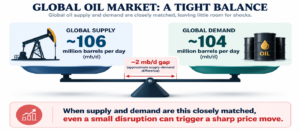
The oil extracted from the Middle East may be put on a tanker, which is then shipped across the sea for delivery to a refinery thousands of miles away.
However, this entire process is based on one assumption: that the oil should be mobile.
This is the reason why the Strait of Hormuz has become the focal point of the current energy crisis.
Why Is the Strait of Hormuz So Important?
The Strait of Hormuz is a body of water that connects the Persian Gulf with the Gulf of Oman and the Arabian Sea. It borders several countries, namely Saudi Arabia, Iran, Iraq, Kuwait, Qatar, and the UAE.
According to the statistics gathered by the EIA, around 20.9 million barrels of oil and petroleum products transited through the Strait daily in the first half of 2025. It represented about one-fifth of total world petroleum consumption and about one-fourth of seaborne oil trade. About 80% of oil transported via the Strait was delivered to Asian markets.
Think about the location of India and China. Both countries require large amounts of foreign oil, and both receive much of their Middle East oil supplies via the Strait. As per the statistics provided in the research materials for the article, in 2025, India and China received about 52% of the oil shipped through the Strait.
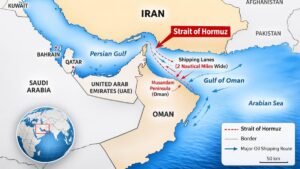
Consider the position of India and China. Both economies depend on large quantities of imported crude oil, and both receive a significant share of their Middle Eastern supplies through this route. According to the figures compiled in the research material for this article, India and China together received approximately 52% of the crude oil exported through the Strait in 2025.
Countries Most Affected by Strait of Hormuz Crude Oil Disruptions
| Country | Share of Hormuz Crude | Volume (Million Barrels per Day) |
| China | 37.7% | ~5.4 (largest buyer of Gulf crude) |
| India | 14.7% | ~2.1 (around 50% of oil imports) |
| South Korea | 12.0% | ~1.7 (around 68% of oil imports) |
| Japan | 10.9% | ~1.6 (around 95% of oil imports) |
Impact of Crude oil in different economies
United States: A Major Oil Producer That Is Not Immune to the Crisis
The United States is one of the world’s largest crude oil producers, with production expected to reach a record level in 2026. However, producing more oil does not automatically protect an economy from a global oil crisis. The ongoing disruption around the Strait of Hormuz has demonstrated this: the United States has increased oil exports to help replace disrupted Middle Eastern supplies, but its own fuel prices and inventories have come under pressure.
During the second quarter of 2026, US crude oil exports surged and exports of refined products increased substantially. According to the US Energy Information Administration (EIA), US distillate exports which include diesel and heating oil averaged approximately 1.56 million barrels per day in Q2 2026, around 30% above the five-year average. (U.S. Energy Information Administration)
However, this additional supply is not unlimited. The EIA reported that US commercial crude inventories fell to their lowest seasonal level since 2014 by the end of Q2, driven partly by high exports and strong refinery activity.
This creates a significant constraint: Washington can release additional barrels to ease immediate shortages, but it cannot rely indefinitely on emergency reserves to compensate for disrupted production, refining and shipping.
More recently, US crude inventories declined by 3.2 million barrels to 424.1 million barrels in the week ending October 2, 2026. Crude production was approximately 14 million barrels per day, while exports rose to around 4.8 million barrels per day.
The Strategic Petroleum Reserve: A Temporary Cushion
The US government has also relied on its Strategic Petroleum Reserve (SPR) an emergency stockpile designed to help manage severe supply disruptions.
According to Global Energy flow, US commercial crude oil inventories sit at about 424.1 million barrels (excluding the SPR) a 3.2 million barrel draw in the week to 2 October, ending two straight builds, while the Strategic Petroleum Reserve stands at about 283 million barrels, its lowest level since October 1982 and roughly 40% of its 714 million barrel capacity, after a 0.8 million barrel draw in the week (EIA Weekly Petroleum Status Report, w/e 2 October).This matters because the US cannot indefinitely compensate for missing global supplies through a combination of increased exports and emergency stock releases. If the Strait of Hormuz remains unreliable, dwindling inventories could leave the market more vulnerable to further shocks. (Federal Reserve Bank of Dallas)
Higher Oil Prices Are Becoming a Domestic Political Problem
The impact is also visible in the US consumer market. Before the conflict began, US petrol prices were below $3 per gallon; by early May, a report cited prices above $4.45 per gallon. Higher fuel prices affect household budgets, transportation, logistics and the cost of moving goods across the economy. They can also make inflation harder to control, complicating the Federal Reserve’s task of bringing inflation down without damaging economic growth.
Hurricane Isaias forced US Gulf of Mexico producers to shut in approximately 1.5 million barrels per day of crude oil production around 72% of the region’s output as of October 9, 2026 and 1.3 billion cubic feet per day of natural gas production (around 59%) as of October 9, 2026. The storm also put approximately 500,000 barrels per day of refining capacity at risk, potentially tightening already-constrained fuel supplies. US Gulf of Mexico normally contributes around 14–15% of total US crude oil production. The disruption adds further pressure to an already strained global oil market.
This creates a political challenge for the Trump administration ahead of the US midterm elections. While Washington wants to maintain pressure on Iran and protect shipping through the Strait of Hormuz, prolonged disruption risks keeping energy prices elevated for American consumers. Government efforts to secure shipping routes, release emergency reserves or facilitate additional oil supplies may ease the pressure, but none guarantees a quick return to normal prices.
For India, the US is therefore an important alternative source of supplyas India is buying gas,oil from them but American exports alone cannot guarantee that sufficient crude will reach Indian refineries at the right time and at a reasonable delivered cost. The decisive factors remain the volume of oil available globally, the ability to transport it safely, and the freight and insurance costs required to deliver it.
China: Can It Ease the Global Diesel Crisis?
In 2022, China helped cool global diesel prices by increasing exports. After issuing additional export quotas in September, Chinese refiners were exporting approximately 680,000 barrels of diesel per day by November, helping ease the global market tightness following Russia’s invasion of Ukraine.
China has again emerged as a potential source of relief. According to Vortexa data cited by The Wall Street Journal, Chinese diesel exports rose to approximately 500,000 barrels per day in September 2026, up from an average of 166,000 barrels per day between April and July. Meanwhile, Chinese refineries are operating at just 75% of capacity, compared with approximately 97% for US refineries, leaving room to increase output. However, analysts are sceptical that China will repeat its 2022 export surge, as Beijing prioritises domestic fuel availability amid depleted inventories and uncertain crude supplies. The Wall Street Journal report
Following a brief suspension of fuel exports during China’s National Day holiday , Beijing approved approximately 3.7 million tonnes of gasoline, diesel and jet fuel exports for October 2026, compared with slightly more than 4 million tonnes in September. Although exports have resumed, analysts expect the additional supply to provide only limited relief to global fuel markets.
The question now is whether China’s renewed exports can meaningfully ease the diesel shortage or whether domestic supply concerns will prevent it from playing the same role it did in 2022.
Russia: Ukrainian Strikes Deepen the Global Diesel Shortage
Russia has 32 major refineries with approximately 6.5 million barrels per day (mb/d) of installed refining capacity. However, intensified Ukrainian drone attacks have severely disrupted its refining industry. In June 2026, Russian refinery throughput fell to 3.8 mb/d the lowest in more than 20 years and around 30% below the previous year & around 50% of russian capacity has been hit by Ukraine and that refining capacity can’t come back online as quickly because of Russian sanctions. Ukraine has targeted both crude distillation units (CDUs), which initially process crude oil, and secondary processing units that convert it into products such as diesel and petrol. Damage to complex units can take six to eight months to repair.
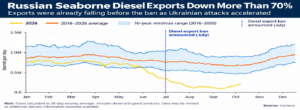
The disruption has forced Russia to prioritise domestic fuel supplies. After banning gasoline exports in April and jet fuel exports in June, Russia introduced a diesel export ban on July 8, 2026. The ban was subsequently extended through August and September as refinery attacks continued and seasonal agricultural demand increased during the harvest period.
2. Current Situation: Rising Fuel Prices and Imports
Despite export restrictions, domestic shortages intensified. By the end of June, fuel shortages had been reported across 92% of Russian regions, with two-thirds introducing rationing measures. By August 26, gasoline prices had increased by more than 19% and diesel prices by approximately 18% since the beginning of the year. Russia has consequently begun importing gasoline from Belarus, Kazakhstan, Morocco, South Korea, India and Türkiye to support domestic availability.
The consequences extend beyond Russia. Global seaborne diesel and gasoil exports averaged 4.7 mb/d during January–August 2026, down 10% year-on-year. In August, combined Russian and Middle Eastern diesel exports fell to just 520,000 barrels per day, 75% below the same month a year earlier. Increased shipments from the United States and a recovery in Asian exports have provided only partial relief.
Source – IEA analysis of Russian refining
3. Latest Development: Trump–Putin Diesel Deal
On October 9, President Donald Trump announced an agreement with Vladimir Putin under which Russia would supply more than 300,000 tonnes of diesel immediately, followed by another 500,000 tonnes in November and 1 million tonnes thereafter. The US also temporarily eased sanctions on Russian fuel to facilitate supplies. The announcement came amid rising American fuel prices and political pressure ahead of the November midterm elections. Reuters report, October 9, 2026
However, the deal’s impact remains uncertain. Analysts expect the additional volumes to provide limited relief because the underlying problem is not simply a shortage of crude oil; it is also the loss of refining capacity and the disruption of fuel exports. The US uses approximately 3.6 million barrels of diesel a day, so even if Russia delivers its promised 300,000 tons this month, that amounts to approximately half of the US daily consumption , only 1 day with 5 lakh tonnes and 2 days with 1mn of diesel .Americans may not notice much of an immediate difference.
The larger concern for global markets is that Russia historically a major diesel exporter is struggling to maintain its own fuel supply while Ukrainian attacks continue to reduce the volumes available to international buyers.
India: Rising Oil Prices Threaten the Economy, but Refining Capacity Offers an Opportunity
India imports approximately 85% of its crude oil, 60% of its LPG and 50% of its LNG requirements, leaving the economy vulnerable to disruptions in global energy supplies. The Middle East remains a critical source: in 2025, the region accounted for approximately 46% of India’s crude oil imports, 66% of its LNG imports and 90% of its LPG imports. Consequently, disruptions to energy shipments through the Strait of Hormuz can affect not only crude availability but also cooking gas, industrial energy costs and transportation. (HDFC Mutual Fund)
Higher crude prices increase India’s import bill, putting pressure on its trade balance and current account deficit (CAD). Against a baseline Brent price of $65 per barrel, a $10 increase in crude prices, accompanied by an equivalent change in gas prices, could add approximately $20 billion, or 0.5% of GDP, to India’s CAD in FY27. (HDFC Mutual Fund)
The impact can extend to inflation and economic growth. The RBI’s October 2025 Monetary Policy Report estimated that a 10% increase in crude prices relative to its baseline could raise inflation by approximately 30 basis points and reduce GDP growth by around 15 basis points, assuming full pass-through to domestic prices.
However, India’s vulnerability has declined over time. Crude oil imports as a share of GDP fell from approximately 8.5% in 2012 to 4.8% in 2025, providing some protection against external energy shocks. Strong services exports also offer support: exports reached approximately $348.4 billion during the first ten months of FY26, around 9% higher year-on-year. Nevertheless, the duration of the disruption and the extent to which higher costs are passed on to consumers will remain critical.As of CY25, while 35% of India’s LPG consumption is domestically produced and 65% is imported, nearly 80% of the 35% of domestic production comes from processed imported crude oil. (HDFC Mutual Fund)
Could India Fill China’s Fuel-Export Gap?
India’s vulnerability to expensive energy imports comes alongside an opportunity: its substantial refining industry could help replace some of the refined fuels missing from global markets.
According to Reuters, India has the world’s fourth-largest refining capacity, at approximately 5.6 million barrels per day. In 2025, it exported 47 million tonnes of fuel, compared with China’s 25.4 million tonnes. However, Indian fuel exports declined by 23% during the first nine months of 2026 amid the Iran conflict and higher domestic export duties.
There are signs that exports could recover. Middle Eastern oil deliveries to India reached 11.3 million tonnes in September 2026, their highest level since February, while two consecutive cuts to fuel-export taxes have improved the conditions for overseas shipments. India could redirect some exports towards markets less affected by the Iran conflict, including Singapore, Australia, Indonesia and the Philippines.
India could therefore emerge as an important alternative supplier of refined fuels if Chinese exports remain unpredictable and sufficient crude reaches Indian refineries. However, this opportunity is conditional: India must balance overseas demand against domestic fuel requirements while managing higher crude, freight and insurance costs. Its refining capacity provides an advantage, but whether that translates into a sustained increase in exports will depend on how the global supply disruption evolves. (Reuters)
Why Oil Prices React Before the Shortage Fully Appears
Oil is traded in a global market where prices reflect not only the supply and demand visible today, but also expectations about future availability.
Suppose a refinery expects to receive 1 million barrels next month. If a geopolitical event makes that delivery uncertain, the refinery may immediately begin searching for alternative supplies. Other refiners may do the same.This additional demand for available cargoes can push prices higher before the actual shortfall reaches consumers.
However, it would be incorrect to attribute every oil-price increase to speculation. Physical supply disruptions, inventory levels, production decisions, transportation costs and expectations all interact with one another.
Research published by the International Monetary Fund examined the role of speculation in oil-price volatility and estimated that noise trading could account for approximately 3% to 22% of short-term oil-price volatility, depending on the model and period studied. That does not mean speculation explains 3% to 22% of every oil-price increase, nor does it mean the remaining movement is entirely attributable to physical shortages.
Can Saudi Arabia and the UAE Bypass the Strait of Hormuz?
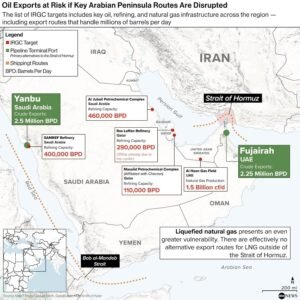
With the Strait of Hormuz severely disrupted, Saudi Arabia and the UAE have two major pipeline alternatives that can help maintain crude oil exports. However, these routes cannot fully replace the volumes normally shipped through Hormuz.
- Saudi Arabia’s East–West Pipeline: This 1,200-km pipeline transports crude from the Persian Gulf region to Yanbu on the Red Sea. Its capacity has been reported at around 5–7 million barrels per day, making it a critical alternative when Hormuz is disrupted.At one point this year 4% of supply use to pass through this route
- UAE’s ADCOP Pipeline: Connecting Habshan to Fujairah on the Gulf of Oman, ADCOP has an estimated capacity of approximately 1.5–1.8 million barrels per day.

- Bab el-Mandeb Strait: Unlike the other two, this is a maritime chokepoint not a pipeline. It connects the Red Sea with the Gulf of Aden and the Indian Ocean. Oil flows through it averaged approximately 4.2 million barrels per day in the first half of 2025, down from 9.3 million barrels per day in 2023.
When the Alternative Routes Come Under Threat
The problem is that bypassing Hormuz does not eliminate geopolitical risk; it can simply shift that risk elsewhere.
In September 2026, Saudi Arabia temporarily shut its East–West Pipeline following a drone attack reportedly originating in Iraq. The pipeline normally transports approximately 4–5 million barrels of oil per day, making the disruption significant. Importantly, reports attributed this attack to a different source not the Houthis.
Meanwhile, fighting around Bab el-Mandeb has intensified. On October 5, Saudi-backed Yemeni forces advanced against Houthi positions near the strait. The Houthis responded by claiming attacks on Saudi targets, including an Aramco refinery in Rabigh; those specific claims were not independently verified in the report. On October 10, a deadly attack struck Riyadh’s King Khalid International Airport, with the Houthis suspected of responsibility. These developments highlight the growing security risks facing Saudi Arabia, although they do not establish that Bab el-Mandeb is completely blocked or that the pipelines are all simultaneously offline. (Reuters)
Why This Matters for Global Oil Prices
These alternative routes provide important flexibility, but their combined capacity cannot replace the roughly 20 million barrels per day of oil and petroleum liquids that normally transit Hormuz. If pipeline operations are disrupted and shipping through Bab el-Mandeb becomes less secure, fewer barrels may reach international buyers on time. Longer voyages, higher freight costs and increased insurance premiums can add further pressure.
The key risk is escalation: if attacks on Saudi energy infrastructure intensify and alternative shipping routes become less secure, the volume of crude reaching global markets could fall further, keeping oil prices elevated. However, the actual impact will depend on the extent of infrastructure damage, the duration of disruptions and how quickly operations recover.
The Hidden Cost of Longer Routes: Freight, Insurance and Time
Oil prices are generally quoted in dollars per barrel, but the price of crude is only one component of the final cost of delivering it to a refinery.
Transportation, insurance, port charges and the time required to complete a voyage all influence the delivered price.
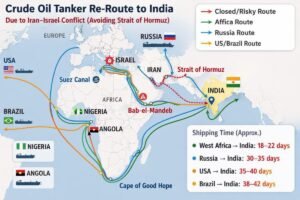
This becomes particularly important when ships avoid the most direct route.
The research material for this article includes an illustrative comparison in which a Middle East-to-India journey takes approximately eight days at a transport cost of $2 per barrel in January 2026 ,while an alternative journey takes around 39 days and costs $27 per barrel in October 2026. The figures should be treated as route-specific estimates rather than universal rates, because actual costs depend on the origin, destination, vessel, freight market and insurance terms.
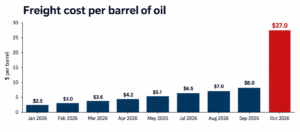
Source- Clarksons Research
Nevertheless, the comparison illustrates how a transportation disruption can change the economics of an oil shipment.
A voyage that takes 39 days ties up a tanker for much longer than one that takes eight days. That vessel cannot complete as many journeys over the same period, reducing the effective availability of shipping capacity. Buyers may need to pay more to secure ships, while sellers may have to wait longer to receive payment for delivered cargoes.
Freight rates have also risen sharply during the current crisis. According to the research material compiled for this article, the cost of transporting crude from the Middle East to Asia aboard a very large crude carrier exceeded $1.2 million per day, compared with approximately $30,000 per day in January. The same source estimated that freight, which previously accounted for around 3% of the delivered price of a barrel, had risen to roughly 27% under the conditions described.
Insurance creates another layer of expense. When the probability of damage to a vessel or cargo rises, insurers can increase war-risk premiums or restrict coverage. The research material also contains estimates of insurance premiums rising from approximately 0.25% of a vessel’s value to a range of 7.5% to 10%. Those figures are highly dependent on the vessel, route, coverage and period, so they should be presented as reported estimates rather than a universal premium applicable to every tanker.
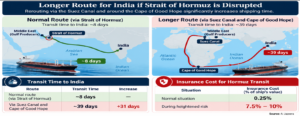
The economic impact is straightforward: even if the crude itself is available, a higher cost of transporting it raises the price paid by the buyer.
For an oil-importing country, this means the effective energy bill can rise through two channels simultaneously. First, the price of crude increases. Second, freight and insurance costs increase the expense of bringing that crude home.
The Risk Extends Into the Next Quarter
The central concern is that the market is losing its ability to absorb additional shocks. Oil flows have partially recovered, but shipping routes remain abnormal, tanker costs are elevated and refined-fuel exports remain constrained. According to OilPrice, these factors have kept Brent around $100 per barrel for approximately a month, while the announcement of further emergency stock releases failed to push prices materially lower.
If supply disruptions persist into the next quarter, the market could face three simultaneous pressures:
- Limited spare inventories: Countries have fewer readily available barrels to release when supply falls.
- Slow recovery: Rebuilding stocks requires additional supply beyond what is needed to meet ongoing demand.
- Further geopolitical disruption: Any renewed interruption to Middle Eastern production, refining or shipping could tighten the market further.
These factors support the risk of oil prices remaining elevated into the next quarter and potentially into 2027.

Why a Shipping Crisis Can Become an Inflation Problem
The consequences of higher oil prices extend beyond the energy sector.
Crude oil is an input into the production of petrol, diesel, aviation fuel and other petroleum products. These fuels are, in turn, essential to transportation, agriculture, manufacturing and the movement of goods.
When fuel costs rise, the effects can spread through the wider economy.
A trucking company may face higher diesel expenses. An airline may pay more for aviation fuel. A farmer may face higher costs for operating machinery and transporting crops. Manufacturers may experience increased logistics costs, while companies that use petroleum-derived inputs may face pressure on their production expenses.
Businesses can respond by absorbing some of the additional cost, reducing their margins, or passing it on to customers through higher prices.
The extent of the inflationary impact depends on several factors, including the duration of the disruption, the movement in local currency exchange rates, government taxation, fuel-pricing policies and the ability of companies to pass on higher costs.
This is particularly relevant for countries that import most of their crude requirements. If the international price of oil rises while the domestic currency weakens against the US dollar, the local-currency cost of imports can increase even more sharply.
The more important question is whether elevated prices persist long enough to affect transportation costs, corporate margins, consumer purchasing power and inflation expectations.
A brief price spike may be manageable. A prolonged period of expensive energy can become a much broader economic challenge.
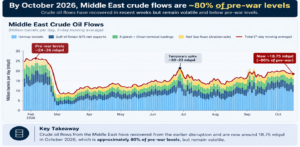
Hormuz Oil Flows Recover to 80% of Pre-War Levels but Prices Remain Elevated
The scale of the disruption becomes clearer when we compare the normal movement of oil through the Strait of Hormuz with the more recent flows.
The report also noted that only seven commodity vessels crossed the Strait on the preceding Tuesday, the lowest daily count since July 23.
The price response has been equally striking. According to the EIA’s October 6 report, Brent spot prices averaged approximately $114 per barrel in September 2026, up around $23 per barrel from August. Brent spot prices reached approximately $131 per barrel on September 15, amid attacks on energy infrastructure and tankers.
These are spot-price figures. Futures prices can trade at different levels, so a futures-chart peak should not be presented as though it were the Brent spot price.
Reuters, citing shipping data from Kpler, reported on October 8, 2026, that crude oil movements through the Strait had fallen to approximately 18.75 million barrels per day, equivalent to roughly 80% of the pre-war crude-flow benchmark used in that report.
Strategic Oil Reserves: A Buffer, Not a Permanent Solution
Governments maintain emergency oil stocks for precisely the kind of disruption the world is experiencing.
These reserves can be released when supply is interrupted, helping to provide additional barrels to the market while producers and shipping networks adjust. In March 2026, International Energy Agency member countries agreed to make 400 million barrels available in response to the crisis, which the agency described as its largest-ever collective oil emergency response. According to the research material compiled for this article, approximately 325 million barrels had been released by October, while the G7 announced a further coordinated release of 100 million barrels in October. The timing and accounting of these releases should be checked against the latest IEA statements before publication.
At global consumption of approximately 12.5 million barrels per day, 400 million barrels is equivalent to fewer than 32 days of global petroleum and other liquid-fuel consumption
Still, the calculation illustrates why even a large emergency response cannot indefinitely compensate for a prolonged interruption to supply.
Saudi Aramco CEO Amin Nasser warned at the Energy Intelligence Forum in London on October 5 that the world entered the crisis with almost 10 billion barrels of oil in inventories. Since the conflict began, approximately 3 billion barrels of gross oil supply have been lost, while more than 1 billion barrels have been withdrawn from inventories to compensate for disrupted supplies. Nasser said that less than 6 billion barrels of commercial inventories remain, with most of the remaining volume not practically available to the market and required for running the refineries.
Why Replenishing Inventories Could Take Two Years
Nasser’s warning extends beyond the immediate crisis. He said that rebuilding global oil inventories while continuing to meet demand could take up to two years even after the Strait of Hormuz fully reopens. He also indicated that the market would need approximately 2 million barrels per day of additional supply for the next 18 months to replenish depleted inventories.
This distinction matters because reopening Hormuz would not automatically restore the global oil market to its previous position. Producers would need to supply enough oil to meet current consumption and rebuild stocks simultaneously. Until that happens, the market would have a smaller buffer against further disruptions.
The pressure also extends beyond crude oil. Kuwait Petroleum Corporation CEO Shaikh Nawaf Al-Sabah estimated that the global market was facing a shortfall of approximately 6 million barrels per day of refined products, reflecting the impact of reduced Middle Eastern refinery output. He warned that the world’s available refining capacity was insufficient to replace all the capacity shut down in the Gulf
There is also a distinction between emergency reserves and normal commercial inventories. Governments hold emergency stocks for exceptional situations, while commercial inventories support the day-to-day functioning of refineries, traders and distributors. Both can help cushion a disruption, but their availability, location and release mechanisms differ.
Diesel Crises
The price of diesel fuel which moves tractors, trains, and ships around the world has recently surged, almost doubling in the last two years. The causes of that increase are wide-ranging, from the wars in Iran and Ukraine to policy decisions in Europe and Asia. The resulting crisis is already hitting anyone who uses a diesel-powered vehicle and could soon affect consumers everywhere.
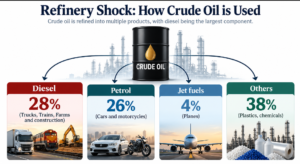
In the late 1980s, diesel cars accounted for just 10–11% of European passenger cars. By the early 2010s, their share had crossed 50% alongside over 90% of vans ,96% of trucks & 92% of buses a remarkable transformation driven by three factors.
First, technological advantage. European automakers, particularly Mercedes-Benz, developed increasingly efficient diesel engines. Turbocharging and common-rail fuel injection improved performance and fuel economy, making diesel attractive even for smaller passenger cars.
Second, government policy. European policymakers prioritised fuel efficiency and lower emissions. Diesel engines appeared to offer a practical way to reduce fuel consumption without abandoning conventional internal combustion engines. Policies favouring fuel efficiency helped accelerate their adoption.
Third, refinery economics. Refineries produce a mix of products, including petrol, diesel and other fuels, in proportions influenced by crude quality and refinery configuration. As European diesel demand increased, it created a ready market for diesel production, aligning the interests of automakers, policymakers and refiners.
The long-term consequence: Europe built its automotive industry around diesel technology but became increasingly dependent on diesel supplies that its domestic refining system could not fully provide. According to the argument presented here, this focus also distracted European automakers from the transition towards hybrid and battery-electric vehicles, where competitors such as Toyota and later Tesla and BYD established strong positions.
Domestic refining meets approximately 85% of EU diesel demand, while the remaining 15% is covered by net imports. The EU is therefore structurally short of diesel but comparatively long on petrol: it can have surplus petrol available for export while still needing to import diesel.
Europe’s diesel demand is so high that its domestic refining capacity cannot always meet it.
According to European Commission research and FuelsEurope, Europe historically developed refineries configured to produce relatively large quantities of petrol. However, European consumers increasingly favoured diesel-powered vehicles, particularly because diesel historically received more favourable fuel taxation in many EU countries along with the fuel effiency it provides against petrol. This created a structural imbalance: Europe produces more petrol than it consumes, but its diesel demand exceeds domestic production.At the same time, some European refineries can produce a surplus of petrol while the region continues to depend on imports to meet its diesel demand, as clearly visible in this chart.
This is the structural mismatch: a surplus of petrol does not necessarily mean sufficient diesel availability.
A refinery is an industrial plant that may require technical modifications and significant investment to change its product mix. It cannot automatically convert a petrol surplus into diesel.
Europe consumes approximately 7 million barrels of diesel per day and produces around 6 million barrels domestically, leaving it dependent on imports to cover the remaining 1 million barrels daily. In September 2026, however, diesel imports fell to a record low for that month, averaging just 1 million barrels per day 600,000 barrels per day below September 2025.
The U.S. supplied approximately 400,000 barrels per day, or 41% of Europe’s September imports, making it the region’s largest external supplier. But with American diesel prices surging, President Trump has threatened to restrict exports and prioritise American consumers, creating uncertainty over whether Europe can continue relying on U.S. supplies.
Europe has also relied heavily on the Middle East, particularly Saudi Arabia, to replace Russian diesel supplies lost after sanctions. Yet this alternative is under pressure too: regional exports of refined fuels remained significantly below pre-conflict levels in September, despite a recovery in crude shipments.
The squeeze is worsening because European refinery output fell by approximately 800,000 barrels per day in September compared with August, as maintenance reduced operating rates. Meanwhile, diesel cargoes already travelling towards Europe were more than 25% below year-earlier levels, signalling that October arrivals could remain weak.
PROBLEMS WITH EU
Problems with the European Union
1. Declining Domestic Refining Capacity
Since 2009, Europe has closed approximately 30 refineries, reducing its ability to produce fuels domestically. Estimates suggest that EU refining capacity has shrunk by roughly 22–30%, while domestic diesel production has fallen by around 800,000 barrels per day (kb/d). This leaves Europe increasingly dependent on imported refined fuels, particularly during seasonal refinery maintenance and ahead of winter, when heating-fuel demand can rise.
2. Losing Russian Supplies and Increasing Import Dependence
Following Russia’s invasion of Ukraine, the EU restricted Russian oil and petroleum-product imports, forcing Europe to find alternative diesel suppliers. European diesel imports from Russia fell from 29.9 million tonnes in 2022 to 2.9 million tonnes in 2024 a decline of around 90%. Europe partly replaced these barrels with supplies from the Middle East, the US and India, but this shifted rather than eliminated its dependence on external suppliers. European Commission: EU energy sanctions
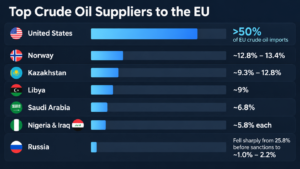
3. Disruption to Middle Eastern Supply Routes
The conflict involving Iran and disruption around the Strait of Hormuz have put Gulf oil and refined-fuel shipments under pressure. Europe also faces exposure to the Bab el-Mandeb shipping route: GTPO estimates that, before the Houthi campaign in late 2023, routes potentially reliant on this chokepoint carried up to 58% of EU diesel imports and 66% of jet-fuel imports. These vulnerabilities mean that disruption to key maritime routes can quickly tighten Europe’s fuel supply.
4. Dependence on US Diesel and Export-Policy Risk
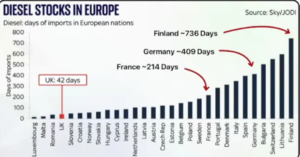
Between February and June 2026, EU diesel imports from the US reportedly doubled year on year, making American supply increasingly important. However, Washington’s subsequent threat to restrict diesel exports showed that this dependence carries its own geopolitical risk. The US reportedly urged the EU to release 120 million barrels over six months as its visible from the image below that how much days of reserves does EU have , illustrating how domestic political pressure in America can affect Europe’s access to fuel as mid-term elections are coming and Trump wants diesel prices to be down to win the elections thereby forcing EU to release their reserves
5. Limited Ability to Replace Lost Supply
Replacing disrupted imports is not straightforward because refineries cannot instantly increase production, and many European facilities were designed to process particular crude grades. The crude slate available to Europe has shifted away from some medium-sour grades for which its refineries were built, while Gulf disruptions have intensified competition between European and Asian buyers for suitable crude. With global refineries already operating at high utilisation, additional diesel supplies cannot be brought online quickly.
6. Diesel Prices Hit Record Highs Across Europe
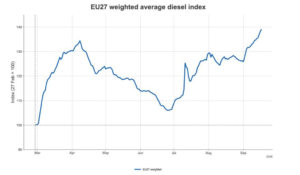
The combined impact of disrupted Middle Eastern supplies, reduced Russian refining output, limited global refinery capacity and seasonal maintenance has pushed European diesel prices to unprecedented levels. According to the IRU report published on 18 September 2026, the EU’s weighted-average diesel price reached €2.26 per litre on 17 September, up 38% since 27 February 2026 surpassing the previous 34% increase recorded in April. Prices in Poland, Bulgaria and Czechia had risen by close to 50%, while Germany’s diesel price had increased by 43% since February. The crisis highlights how Europe’s dependence on imported diesel, combined with constrained refining capacity and vulnerable shipping routes, is translating directly into higher fuel costs for businesses and consumers.
The Global Diesel Crisis: Why Is the World Facing a Shortage?
Before We Begin: Why Is Diesel Demand More Price-Inelastic?
Price inelasticity means that even when prices rise sharply, demand falls only slightly because consumers cannot easily reduce their consumption.
According to the estimates in the chart, a 10% price increase reduces petrol demand by around 3%, but diesel demand by only 0.7%. Trucks must deliver goods, farmers must harvest crops, and industries must operate making diesel difficult to replace in the short term.
Where Does the Problem Start?
1. The United States: Record Exports, Declining Inventories
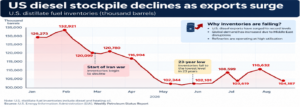
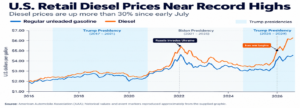
The US exported a record 1.6 million barrels of diesel per day in August 2026, while its diesel inventories fell to multi-year lows. Disruptions to Middle Eastern supplies increased global demand for American fuel, but high exports and limited spare refining capacity also tightened US domestic supplies. Washington consequently considered restricting exports and urged European countries to release emergency reserves as a result the national average price of diesel in the U.S. has increased by nearly 70% (rising roughly $2.50 to $2.60 per gallon), jumping from around 3.70–3.76 per gallon just before the U.S.-Israel war with Iran began on February 28, 2026, to approximately $6.28 to $6.51 per gallon by October 2026, according to data from AAA
The problem: The US is supplying more diesel to the global market even as its own inventories are under pressure. However, an export restriction could tighten supplies for countries that depend on American diesel.
2. Russia: Ukrainian Drone Attacks Disrupt Refining
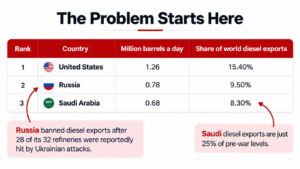
Ukrainian drone strikes have damaged Russian refineries and reduced the country’s ability to produce and export diesel. According to the International Energy Agency (IEA) and media tracking, 27 to over 30 major Russian refineries out of Russia’s ~32 to 38 large oil refineries have been hit or damaged by Ukrainian long-only drone strikes since the escalation of the war. S&P Global reported that attacks had pushed approximately 3.8 million barrels per day of Russian refining capacity offline, while Russia’s export restrictions further reduced supplies available to international buyers.
The problem: Russia is a major global diesel supplier. When its refineries go offline and exports decline, buyers worldwide must compete for fewer available cargoes.
3. Middle East: Conflict Disrupts Oil and Diesel Supplies
The conflict involving Iran has severely disrupted shipments through the Strait of Hormuz. According to the IEA, Gulf countries’ net diesel and gasoil exports averaged just 390,000 barrels per day in August 2026 slightly more than a quarter of pre-war levels. Saudi oil flows have also faced disruption which contributes 8.30% of world diesel exports, adding pressure to an already constrained market.
The problem: The world is losing significant diesel supplies from the Gulf just as Russian exports are also constrained. Other refineries cannot quickly compensate because many are already operating near capacity.
4. Europe: Structural Dependence Makes the Crisis Worse
Europe has closed approximately 30 refineries since 2009, while its domestic diesel production has reportedly fallen by around 800,000 barrels per day. It also lost much of its Russian diesel supply following EU sanctions and became more dependent on imports from the US, the Middle East and India. Disruptions to shipping routes and uncertainty over US export policy have exposed this dependence.
The problem: Europe needs imported diesel but has limited short-term flexibility to replace lost supplies domestically. Seasonal refinery maintenance and rising winter demand can make the situation more difficult.
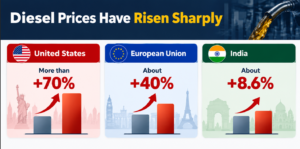
5. The Result: Diesel Prices Have Risen Worldwide
The simultaneous pressure on US inventories, Russian refining, Middle Eastern shipments and European supply has driven diesel prices sharply higher as visible from the below image
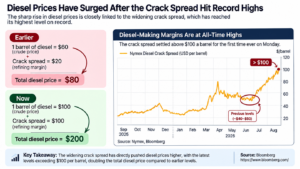
So, we have seen how global diesel inventories are falling, major exporters like Russia and Saudi Arabia are facing supply disruptions, and diesel prices have surged across the US, Europe and India. But the real problem goes beyond rising crude oil prices: the crack spread has also widened sharply, reaching record levels.
To understand this, crack spread is the difference between the price of crude oil and the selling price of refined products like diesel. For example, if crude costs $60 per barrel and the crack spread is $20, their combined value is $80. But when crude reaches $100 and a diesel shortage pushes the crack spread to $100, the combined value rises to $200.
India: The Unexpected Outlier in the Global Diesel Crisis
India is the world’s fourth-largest refining centre, with more than 5 million barrels per day of refining capacity. Government data put installed capacity at roughly 267 million tonnes annually as of April 2026.
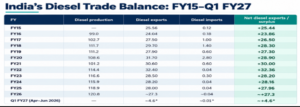
India has generally been a net diesel exporter since 2015, supported by strong domestic refining capacity as visibe from this image
India’s refining capacity stands at 5.36 million barrels per day (b/d), projected to reach 5.8 million next year and 6.4 million by 2032.
The government has also reduced export taxes: diesel from ₹25 to ₹16 per litre and ATF from ₹19 to ₹10.50 per litre. Higher export earnings can partly offset pressure in the domestic market, helping cushion consumers from global price increases.
In September 2026, India exported roughly 620,000 barrels per day (bpd) of diesel, the highest level in about a year. Even more strikingly, around 280,000 bpd nearly 45% went to Europe, an increase of about 80% from August and they have also done exports to various countries as shown below in the table as well.
| Destination | Indian Diesel Exports (Barrels per Day) | Share of Total Exports |
| Europe | 280,000 | 45.2% |
| Africa | 200,000 | 32.3% |
| Asia | 50,000 | 8.1% |
| Americas | 40,000 | 6.5% |
| Unknown | 50,000 | 8.1% |
| Total | 620,000 | 100% |
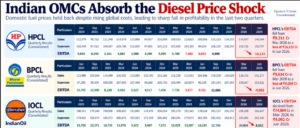
But if US diesel prices have risen over 70% while India’s have increased just 8.62%, who is absorbing the difference?
Its because much of the pressure is being absorbed by India’s public-sector oil marketing companies (OMCs) Indian Oil Corporation (IOC), BPCL and HPCL. By limiting domestic price increases despite rising fuel costs, these companies have taken a hit to their profitability. They held the prices and abosrbed a loss of 530 crs a day
Current Developments: Emergency Reserves, Russian Diesel and Trump’s Midterm Pressure
1. The U.S. Pressures Europe to Release Diesel Reserves
With U.S. diesel prices surging, the Trump administration reportedly pressured Germany and France to release emergency fuel reserves, warning that Washington could restrict U.S. diesel exports if Europe did not cooperate. The U.S. reportedly asked the EU to release 120 million barrels over six months. The pressure reflects a political reality: with U.S. congressional midterm elections scheduled for November 3, 2026, high fuel prices are becoming a domestic problem for Trump, raising transportation and farming costs and angering voters. (Reuters)
The threat of an export ban was significant because Europe had become increasingly dependent on U.S. diesel imports. Restricting those exports could hurt European supplies while also disrupting U.S. refiners, who need overseas markets for some of their output. Ultimately, G7 countries agreed to release 100 million barrels of oil and refined fuels over four months, with a substantial diesel release planned within the first 20 days. Germany has committed up to 15 million barrels, while France and Italy have each committed around 10 million barrels. This can add supply and ease prices temporarily, but it is a drawdown of existing stocks not new production. (Consilium)
2. Trump Turns to Russia for Diesel Ahead of the Elections
In a striking geopolitical reversal, Trump announced a deal with Vladimir Putin for Russia to supply diesel to the U.S. and global markets. Trump said Russia would deliver more than 300,000 tonnes immediately, another 500,000 tonnes in November, and 1 million tonnes thereafter, with a further 3 million tonnes conditional on the condition of Russian refineries. The U.S. Treasury subsequently issued a temporary licence allowing specified transactions involving Russian-origin diesel until April 7, 2027 not April 1 as a result US diesel futures fell almost 5% following news of the deal and were trading at $4.64 a gallon.
The timing is crucial. With U.S. diesel prices near record levels and midterm elections approaching, Trump has a strong political incentive to find additional fuel supplies and show voters that his administration is acting.
But will this bring diesel prices down substantially? Not necessarily. These shipments can provide some relief, but analysts have cautioned that the additional volumes may be too small to resolve a global shortage driven by damaged refineries, disrupted shipping routes and limited refining capacity. The reserve release and Russian deal are therefore best understood as short-term supply measures shaped by urgent political pressure, rather than a permanent solution to the diesel crisis. (AP News)
Final Conclusion: The Global Diesel Crisis Could Extend Into 2027
The world is currently facing what could become a long-term crisis of diesel, with the effects expected to go way beyond the energy sector, as the global diesel crisis has brought about an estimated loss of export and refinery capacity of around 1.7 million to 2 million barrels per day, implying a shortage of about 8% of the global diesel supply. The International Energy Agency has projected that there is a fall of around 1.6 million barrels per day in diesel and gasoil exports by Russia and the Gulf compared to February 2026, with refinery strikes, disruption in transportation channels, sanctions, and export bans adding to the constraints in the refined fuel supply.
There is also no hope in sight when it comes to the price projection. Goldman Sachs has forecasted the diesel and jet fuel refining margin to be above $40 per barrel for the year 2027 compared to the usual level of around $20 per barrel, nearly thrice its ten-year average of around $17. This implies that even in the case of the gradual return of crude oil supply, diesel will remain pricey.
However, emergency stock releases and new supplies of Russian diesel can only be considered a temporary solution, and neither will definitely bring permanent stability. The United States consumes about 3.6 million barrels of diesel fuel a day; therefore, the supply from Russia equal to 300 thousand tons in the next month will only account for half of daily US consumption. Americans will feel little difference right away.
The main problem is that, along with crude oil, the world requires enough functional refineries and secure shipping routes, which would enable producing diesel fuel from it. Otherwise, high fuel prices could affect prices of transportation, agriculture, manufacturing, the food industry, and other fields within importing countries.
The most dangerous threat for the future is not only the growth of prices for crude oil itself but the inability to produce and deliver enough diesel fuel at the required pace. With big exporters such as the USA, Russia, and Saudi Arabia under pressure, low inventories, and refining margins staying high until 2027, the diesel fuel market may stay tight for months.
A sustained recovery will depend on the restoration of disrupted supply routes, the return of refinery capacity, and the easing of export restrictions, not merely a fall in crude oil prices.
What Does the Global Energy Crisis Mean for Investors?
1.Energy Crisis Could Fuel Global Inflation
If crude oil remains above $100/barrel and diesel supplies remain constrained, transportation and logistics costs could rise, pushing up the prices of food, raw materials and everyday goods. The potential impact of El Niño on agricultural production could add further inflationary pressure, particularly in India.
2. Impact of Rising Crude Oil on India
India imports nearly 85% of its crude oil requirements, making it vulnerable to sustained price increases. Every $10/barrel increase above $90 could add $15–17 billion (approximately 0.4% of GDP) to India’s annual import bill and potentially raise inflation by 30–50 basis points (0.3–0.5 percentage points). According to Bernstein estimates, each $10 increase above $90 could also reduce Nifty earnings by approximately 2–3%. If crude prices remain above $100/barrel, India could face higher inflation, rupee depreciation and weaker corporate earnings, increasing downside risks for the equity market.
3. Rising Inflation Could Keep U.S. Bond Yields Elevated
Persistent energy inflation could make it harder for the Federal Reserve to achieve its 2% inflation target. Meanwhile, the U.S. government’s fiscal deficit and heavy borrowing requirements are increasing Treasury supply, while hyperscalers are raising substantial debt to finance AI infrastructure. These factors could keep long-term bond yields elevated. The U.S. 30-year Treasury yield recently approached 5.73%, its highest level since 2000.
4. Higher Bond Yields Could Pressure Equity Markets
When Treasury yields rise, bonds become more competitive with equities. Higher discount rates also reduce the present value of future corporate earnings, particularly for growth and technology companies. If earnings weaken alongside falling valuations, equity markets could face a significant correction.
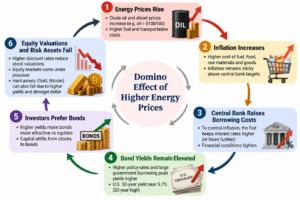
5. Hard Assets Could Also Face Pressure
Higher real yields and a stronger dollar could weigh on gold as it does not provide any yield, while tighter financial conditions could pressure Bitcoin and other risk assets.
If you need guidance on how to start your stock market journey, how much capital is enough to begin with, how to do smart investing, or how to take informed stock market decisions, you can join Strategic Alpha’s ‘The Conviction Club’. This is a membership program, especially curated to help investors become aware and knowledgeable about stock market trends, news, and technical aspects, so that they can become their own experts.
Our YouTube channel, weekly webinars, and digital resources available on the website can help you learn the basics of the stock market. For regular updates on trends, one-to-one sessions with experts, and detailed learning modules, you can join the Conviction Club, which is the online community of like-minded investors sharing knowledge and thoughts to grow together.
Subscribe to the Strategic Alpha Newsletter now to get the latest updates about weekly webinars.
Join Me On My Telegram Channel Where I Share Much More Value Adding Knowledge Of Investing/ Trading: Click Here
Also, Don’t Forget To Follow Us On Our Social Media Accounts:
Facebook: https://www.facebook.com/strategicalpha/
Instagram: https://www.instagram.com/strategicalpha/
Twitter: https://twitter.com/suyog_dhavan
YouTube: https://bit.ly/2IIqztO
Disclaimer: Strategic Alpha and Suyog Dhavan are not SEBI-registered investment advisor. The content provided is purely for educational purposes and should not be construed as financial or investment advice. Viewers are encouraged to conduct their own research or consult with a SEBI-registered professional before making any investment decisions.