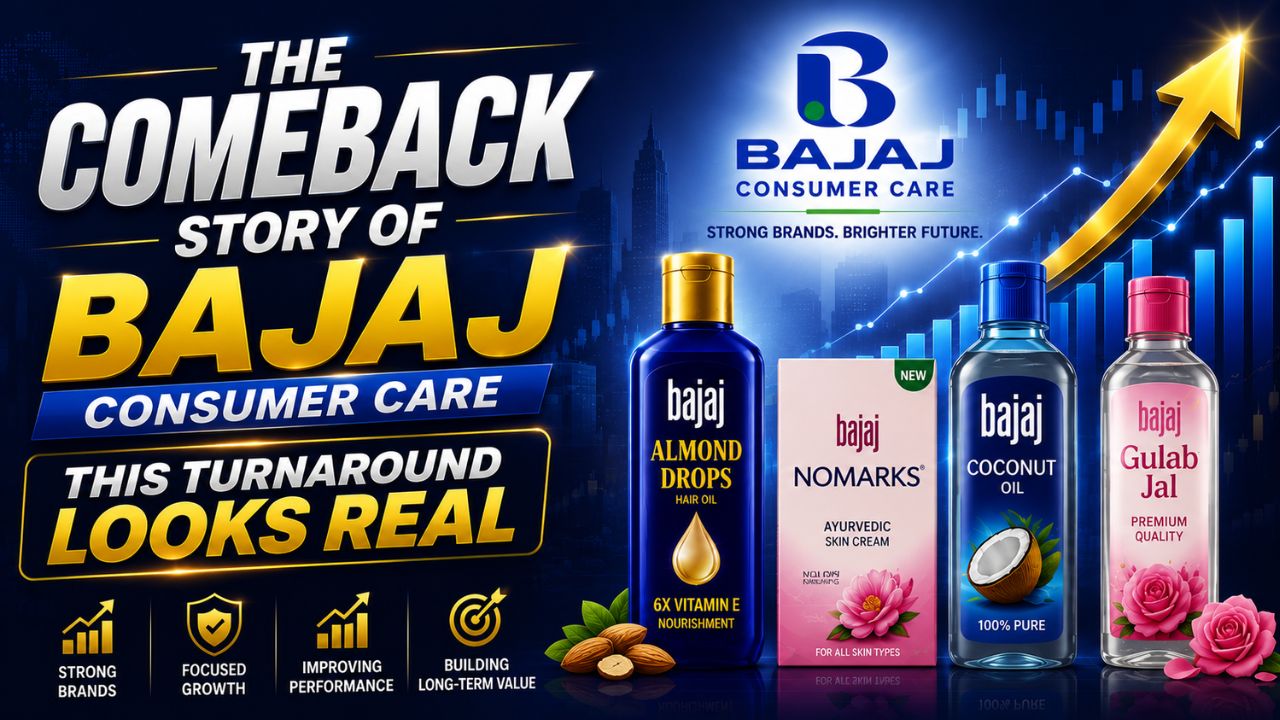
(This is a follow-up on our earlier blog on Bajaj Consumer Care Ltd. after Q3 FY26, where we explored whether the business was showing early signs of a turnaround. With Q4 results now available, this piece revisits that thesis.)
BAJAJ CONSUMER CARE LTD. (A REVISIT): FROM TURNAROUND HOPE TO EVIDENCE
A few months ago, after Bajaj Consumer Care Ltd.’s Q3 FY26 results, the question was straightforward: was this the beginning of a turnaround, or just a strong quarter?
Q4 makes that question harder to ask.
The company has now delivered two consecutive quarters of strong growth, with FY26 revenue at ₹1,153 crore (+21%), EBITDA margins at ~19.5%, and a sharp improvement in quarterly profitability. Management, in its latest commentary, has also indicated that much of the heavy lifting on execution has already been done and the current performance is beginning to reflect that work.
More importantly, the improvement is no longer coming from a single lever. The core brand is growing again, distribution is expanding with measurable impact, and the portfolio beyond ADHO is starting to contribute with greater intent.
That changes the nature of the story.
What looked like an early recovery in Q3 now reads more like the early phase of a more structured shift in the business.
This note revisits that thesis; not to ask whether something has changed, but to understand whether the change is becoming durable.
THE BUSINESS BENEATH THE NUMBERS
Before getting into what has changed, it is useful to step back and understand what Bajaj Consumer Care has historically been, and just as importantly, what it has not been.
At its core, this is a company built around a single brand.
Bajaj Almond Drops Hair Oil (ADHO) has been the backbone of the business for decades. It operates in a category with deep consumer habit, wide penetration, and consistent cash generation. The brand has scale, recall, and a proven track record in its segment.
That strength, however, came with a limitation.
Over time, the business became increasingly dependent on this one product, with a large share of revenues tied to a single category. While the brand remained relevant, the company struggled to build meaningful growth beyond it. New product introductions were attempted, but they remained incremental and did not materially change the growth trajectory.
The result was a business that stayed profitable, but stopped scaling.
For several years, revenues moved sideways. Margins were impacted by input cost volatility, and demand recovery remained uneven, particularly in rural markets which are important for the category. The company was not losing its position, but it was not expanding its opportunity set either.
This was not a broken business. It was a constrained one.
And that difference is important, because businesses constrained by structure can often change direction faster than those facing structural decline.
Management commentary in the recent quarter also reflects this shift in thinking. The focus is now clearly on reviving the core, improving execution, and building adjacencies in a more disciplined manner, rather than just pursuing broad expansion.
The question, therefore, was whether the company could move beyond its dependence on a single engine and begin building a more scalable growth model.
That is the lens through which the recent developments need to be viewed.
WHAT HAS CHANGED: FROM ACTIVITY TO EXECUTION
Turnarounds rarely begin with new products or large announcements. They begin with a shift in priorities, and more importantly, in how those priorities are executed.
In BCCL’s case, that shift has become more visible over the past few quarters.
Under the current leadership, the approach is more structured and sequential. Instead of expanding across multiple categories at once, the company has focused on strengthening the core business first, improving distribution execution, and then building adjacencies more selectively.

The first change is in how the flagship brand is being managed.
Almond Drops Hair Oil is no longer treated as a mature product that can rely on legacy recall. The company has actively intervened across pricing, communication, and visibility. Price corrections were implemented earlier in the year, ml-age adjustments were undertaken, advertising intensity was stepped up meaningfully, and a larger share of spends has moved toward digital channels. Management indicated that advertising spends increased materially through FY26, with Q4 alone seeing a significant year on year increase.
This is now reflecting in performance.
In FY26, the ADHO portfolio delivered more than 20% revenue growth, supported by improving consumer offtake and market share gains. In Q4, management highlighted mid-single digit ml-age adjusted volume growth, which marks a shift from earlier periods that were more dependent on pricing.
That distinction matters.

Growth driven by volumes indicates that demand is improving at the consumer level, not just through price-led expansion. For a mature category, that signals stronger brand relevance.
At the same time, pricing and pack interventions have improved accessibility without diluting the premium positioning of the brand. Distribution execution has also supported this recovery, with better on-ground presence in General Trade, improving rural demand, and steady urban performance helping convert visibility into sales.
What stands out is the alignment.
Brand investment, pricing strategy, and distribution execution are now working together. Earlier, these levers operated more independently. Now, they are reinforcing each other, making growth more consistent and repeatable.
The second shift is in distribution.
Through Project Aarohan, the company is moving toward a more direct and controlled distribution model. This includes expanding direct outlet reach, improving tracking of on-ground execution, and increasing visibility at the point of sale. Management highlighted that markets where Aarohan has been implemented are already delivering a 2 to 4% growth advantage compared to others.
This improves the quality of growth by making it less dependent on short term demand spikes.
The third shift is in portfolio strategy.
Earlier, the company had multiple products but limited impact from them. The current approach is more selective, with a focus on categories where the company has a clear right to play, such as coconut oil and natural personal care. The acquisition of Vishal Personal Care Ltd. and the integration of the Banjara’s brand reflect this direction, adding both category depth and stronger access to southern markets.

Management has also indicated that the focus will remain on scaling a smaller set of brands rather than expanding across too many categories.
Taken together, these changes point to something more than a cyclical improvement.
The business is moving from scattered activity to more focused execution, with clearer priorities and better alignment across brand, distribution, and portfolio decisions.
What is changing here is not just growth, but the quality of growth.
And in consumer businesses, that is often where sustained compounding begins.
EXPANDING BEYOND THE CORE
If the core provides stability, the next question is whether the business can build beyond it.
For BCCL, that second engine has existed for some time, but without meaningful scale. The company had a presence across coconut oil, Amla variants, and personal care products, but these categories did not materially change the overall growth profile.
But that is beginning to change.
In FY26, the non ADHO portfolio contributed ₹225 crore in revenue and the company aspires to scale this portfolio to ₹500 crore over the next 3 years. Within this, Banjara’s contributes roughly ₹50 to ₹60 crore, which is still a small share of the overall business but large enough to track.
More importantly, the portfolio is now being built with clearer focus.
Coconut oil has emerged as a key adjacent category. It allows the company to participate in a high frequency segment within the same hair care basket. The category has seen steady traction, supported by better pricing discipline and more targeted distribution.
Banjara’s represents a different strategic move. It gives the company access to the herbal and natural personal care segment, while also strengthening its presence in South India. This is relevant because Bajaj has historically been stronger in North and Central India. The acquisition therefore brings both category expansion and geographic balance.
The integration is already underway, with the brand showing double digit growth in FY26, and management indicating further scale up through wider distribution.

Beyond these, the company is also working on improving performance across existing categories such as Amla and other personal care products. The approach here is more calibrated, with a focus on improving product fit, distribution, and visibility rather than launching multiple new products.
This reflects a change in strategy.
The company is no longer trying to build a wide portfolio. It is trying to build a relevant portfolio.
At ₹225 crore, the second engine is still smaller than the core, but it is now structured, profitable, and growing.
If it continues to scale alongside a strengthening core, the business gradually moves from being dependent on one driver to being supported by two; and that is when the growth profile begins to change meaningfully.
DISTRIBUTION AS THE UNDERLYING LEVER
In consumer businesses, growth is often attributed to brands and products. Over longer periods, however, it is distribution that determines how consistently that growth can be delivered.
This is where BCCL is strengthening its foundation.
General Trade remains the largest channel, contributing close to 70% of revenues. What is changing is not the importance of the channel, but how it is being managed.
Through Project Aarohan, the company is moving toward a more direct and controlled distribution model, with a focus on expanding direct reach, improving on-ground execution tracking, and increasing visibility at the retail level. Management indicated that markets where Aarohan has been implemented are already delivering a 2-4% growth advantage, which is a meaningful indicator of execution impact.
At the same time, the channel mix is evolving.
Organized Trade now contributes around 30% of sales, with strong growth across modern trade, e-commerce, and quick commerce. These channels are scaling faster than the base business and are becoming increasingly relevant for premium products, new launches, and faster consumer adoption cycles.
Importantly, this is not a shift away from General Trade, but an addition to it.
General Trade continues to provide scale and reach, while Organized Trade enhances visibility, premiumisation, and data-led execution.
Demand trends are also becoming more balanced. Urban markets have remained steady, while rural demand, which had weakened earlier, has shown recovery through the second half of FY26. Given the category’s exposure to rural consumption, this recovery becomes an important support for growth.
What emerges is a more balanced distribution structure, with stronger reach, improving channel mix, and better execution.
It may not be the most visible part of the story, but it is likely to be one of the most important.
MARGINS, CAPITAL ALLOCATION, AND THE QUALITY OF GROWTH
If growth tells you that the business is improving, margins and capital allocation tell you how sustainable that improvement is.
For FY26, the company reported EBITDA of ₹224 crore, with margins at 19.5%. In Q4 alone, EBITDA stood at ₹77 crore, with margins expanding to 23.7%. This is a sharp improvement from the low teens margin profile seen in earlier periods.
What stands out is that this expansion has come alongside higher investments.
Margins expanding while investments increase usually indicate improving efficiency and stronger execution, rather than temporary cost savings.
Companies that are uncertain about the sustainability of earnings typically conserve cash. The recent buyback, while continuing to invest in growth suggests that management sees the current improvement as more durable.
There is, however, an important risk.
Input costs have seen volatility across key raw materials such as light liquid paraffin, packaging materials, copra, and edible oils. Management highlighted that some of these pressures have been influenced by global factors, including supply disruptions. Pricing actions and pack adjustments have helped offset part of this impact, but the full effect of cost movements may still play out over time.
This makes margins less about the peak level achieved in a single quarter, and more about the ability to sustain performance through a volatile cost environment.
If the company is able to maintain margins in this range while continuing to invest in brand and distribution, it would indicate a shift toward a more stable and higher quality earnings profile.
And that is what ultimately drives long term value in consumer businesses.
WHAT THE NEXT PHASE COULD LOOK LIKE
Management commentary suggests that the current phase is less about recovery and more about scaling execution.
| FY26A | FY27E | FY28E | FY29E | |
| ADHO | 928 | 1,039 | 1,164 | 1,303 |
| Non – ADHO | 225 | 292 | 380 | 495 |
| Total Revenue | 1,153 | 1,331 | 1,544 | 1,798 |
If trends sustain, the business could move toward mid-teen revenue growth, supported by a combination of steady performance in the core and faster scaling of the non-core portfolio.
This assumes steady execution and does not factor in any sharp input cost or demand disruptions.
Importantly, this growth is not expected to come at the cost of profitability. Management has indicated a move toward EBITDA margins in the low to mid-20s range, suggesting that the next phase could be driven by better mix and operating leverage rather than aggressive spending.
In that sense, the opportunity is not just about growth in revenue, but about a gradual improvement in the overall quality of the business.
FROM SIGNALS TO STRUCTURE
A few quarters ago, BCCL was a business showing early signs of improvement. Today, it looks like a business that is beginning to find structure again.
The core has stabilised and returned to growth. Distribution is becoming more deliberate. The second portfolio is small but now visible. Margins have recovered while investments have increased. Capital allocation is starting to reflect confidence.
None of these, in isolation, define a turnaround.
Together, they begin to.
The current improvement is being viewed largely as a cyclical recovery. That is understandable given the company’s past track record.
But the underlying changes suggest something more structural. Distribution expansion is now measurable, the core brand is showing volume recovery, and the second portfolio is beginning to reach scale.
If these trends sustain together, the earnings profile of the business could look very different over the next few years.
That is where the real re-rating potential lies.
What stands out is not just that the numbers have improved, but that the drivers behind those numbers appear more aligned than before.
There are still questions. Input cost volatility, the ability to scale the non-core portfolio, and sustaining momentum after a strong year will all need to be watched.
But the lens has shifted.
This is no longer a business trying to recover lost ground. It is a business attempting to rebuild a more scalable growth model.
This is now becoming a story of rebuilding, a story the market may still be underestimating.
(The assumptions presented are based on management commentary and publicly available information, and this note is not intended as an investment recommendation.)
If you need guidance on how to start your stock market journey, how much capital is enough to begin with, how to do smart investing, or how to take informed stock market decisions, you can join Strategic Alpha’s ‘The Conviction Club’. This is a membership program, especially curated to help investors become aware and knowledgeable about stock market trends, news, and technical aspects, so that they can become their own experts.
Our YouTube channel, weekly webinars, and digital resources available on the website can help you learn the basics of the stock market. For regular updates on trends, one-to-one sessions with experts, and detailed learning modules, you can join the Conviction Club, which is the online community of like-minded investors sharing knowledge and thoughts to grow together.
Subscribe to the Strategic Alpha Newsletter now to get the latest updates about weekly webinars.
Join Me On My Telegram Channel Where I Share Much More Value Adding Knowledge Of Investing/ Trading: Click Here
Also, Don’t Forget To Follow Us On Our Social Media Accounts:
Facebook: https://www.facebook.com/strategicalpha/
Instagram: https://www.instagram.com/strategicalpha/
Twitter: https://twitter.com/suyog_dhavan
YouTube: https://bit.ly/2IIqztO
Disclaimer: Strategic Alpha and Suyog Dhavan are not SEBI-registered investment advisor. The content provided is purely for educational purposes and should not be construed as financial or investment advice. Viewers are encouraged to conduct their own research or consult with a SEBI-registered professional before making any investment decisions.