INJECTABLES 101: UNDERSTANDING GUFIC’S CORE BUSINESS
The real challenge is not the vial itself. The medicine must be formulated properly, produced under controlled conditions, filled into a sterile container, and carefully tested for its quality and stability. This makes sterile injectable manufacturing a complex and highly controlled process. When people hear about a pharmaceutical company, one thing they have in mind is tablets, capsules, and syrups. But things are not like that at Gufic Biosciences. More than 80 to 85% of Gufic Biosciences’ turnover is generated through injectables, and hence sterile manufacturing plays an important role in Gufic Biosciences. Gufic Biosciences maintains manufacturing plants in Navsari, Gujarat, and Indore, Madhya Pradesh.
So, what does Gufic Biosciences manufacture? It goes far beyond just filling up medicines in the vial. An injectable is a medication that is either injected or infused into the body rather than being consumed as tablets. The production of injectable medicines involves intricate processes.
Gufic Biosciences produces varied kinds of injectable medications such as lyophilized vials, liquid vials, ampoules, and special types of injectables. Lyophilized injectables are a good example of injectables. Some medications are not stable in liquid form for prolonged periods. In order to enhance their stability, they are freeze-dried in a powdered form. The medicine is reconstituted into liquid form by adding certain liquids to the powder.
The real challenge is not the vial itself. The medicine must be formulated properly, produced under controlled conditions, filled into a sterile container, and carefully tested for its quality and stability. This makes sterile injectable manufacturing a complex and highly controlled process.

The vial is the container. The pharmaceutical product and the process required to manufacture it are where the complexity lies.
Gufic also works with more specialised delivery formats. For example, a dual chamber system keeps the drug and the liquid required to reconstitute it separate until administration, while depot injections are designed to release a medicine gradually over a longer period. These capabilities allow Gufic to operate across several specialised areas.
Where does Gufic operate?
One of its largest areas is critical care and hospital injectables, including anti-infectives, antifungals, antibiotics and other medicines used in hospital settings.
The company also has a fertility and assisted reproductive technology business through Ferticare, which focuses on specialised hormonal and recombinant therapies used in infertility treatment and IVF.
Another area is botulinum toxin and aesthetic medicine, where Gufic has products spanning cosmetic and therapeutic applications.
Then there is contract manufacturing. Gufic manufactures medicines for other pharmaceutical companies, meaning its manufacturing facilities serve both its own products and products belonging to external customers.
Beyond this core, Gufic also has businesses in APIs, peptide APIs, phytomedicine, nutraceuticals and consumer care. These provide additional diversification, but the central manufacturing story remains its injectable business.
The simplest way to understand Gufic
Gufic is not primarily a company built around producing large volumes of conventional oral medicines.
It has built its business around specialised injectable medicines where sterile manufacturing, formulation capabilities and regulatory requirements are important. This explains the company’s biggest operational challenge.
As Gufic expanded its product portfolio, served more customers and increased its export activity, more of that demand had to be handled by the same manufacturing infrastructure.
The question was no longer simply how much demand the company could generate. It was how much it could actually manufacture.
And that is where the story of Indore begins.
THE CAPACITY CEILING: WHY DEMAND WASN’T THE PROBLEM
If Gufic had a specialised product portfolio and customers across domestic, contract manufacturing and export markets, what was holding it back?
The answer was manufacturing capacity.
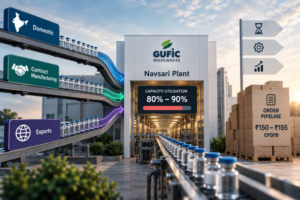
Before Indore became operational, Gufic relied heavily on its facilities at Navsari, Gujarat. Capacity utilisation there had reached roughly 80% to 90%, leaving limited room to increase production further.
High utilisation sounds positive, but for Gufic it had started becoming a constraint.
The same manufacturing lines were being used for three different requirements. Gufic had to produce its own domestic branded products, manufacture medicines for other pharmaceutical companies and fulfil export orders. All three were competing for the same available capacity.
This created a difficult scheduling problem.
In sterile manufacturing, a production line cannot simply move from one medicine to another. Between batches, equipment may need cleaning, sterilisation, preparation and other quality procedures. New products can also require technology transfers and validation batches.
So even when demand existed, the company could not immediately convert that demand into additional production.
When orders started competing with each other
The constraint became visible in Gufic’s order pipeline.
The company had a running order pipeline of around ₹150 crore to ₹155 crore, while management indicated a desire to bring this down towards ₹80 crore to ₹90 crore as manufacturing capacity improved.
The problem was not necessarily that these orders were undesirable. The problem was that there was not enough manufacturing time to execute everything simultaneously.
At one point, export commitments meant that domestic Critical Care and Sparsh orders worth approximately ₹15 crore to ₹20 crore were pushed out. This showed the underlying issue clearly: Gufic had to decide which orders could be manufactured and when.
The result was a prolonged period in which quarterly revenue remained around ₹170 crore to ₹180 crore. The company had additional products and customers, but the existing manufacturing infrastructure was becoming the limiting factor.
Why Indore became necessary
This is what made the Indore project important.
Gufic was not building another facility simply to add capacity in the abstract. The objective was to create additional manufacturing room so that the business could handle more products and customers without everything having to pass through the same constrained infrastructure.
The plan was therefore straightforward in concept:
More manufacturing capacity → more orders can be executed → existing businesses have more room to grow.
The difficult part was that building a pharmaceutical plant is not the same as making it commercially ready.
And that distinction would become the next major chapter in the Indore story.
WHY A FINISHED FACTORY ISN’T A FINISHED BUSINESS
Once manufacturing capacity became the constraint, the solution appeared straightforward: build another facility.
Gufic invested roughly ₹350 crore to ₹355 crore in its new manufacturing facility at Indore. The objective was to create substantially more manufacturing capacity and allow the company to handle products that could not be accommodated at Navsari.
But there was a problem with the way this was initially viewed.
Building a pharmaceutical plant is not the same as making it commercially ready.
A new sterile facility has to demonstrate that it can consistently manufacture medicines under the required quality standards. Equipment needs to be installed and qualified. Utilities such as water, steam and electricity have to meet the required specifications. Manufacturing processes need to be validated. Products have to be transferred from existing facilities and tested. Customers may also need to inspect and approve the new site.
This is what made the Indore timeline considerably longer than initially expected.
From construction to commercial production
The original expectations suggested that the facility would become operational much earlier. Instead, several stages took longer than planned.
One important reason for the delay was that the facility underwent review by an external consultant with US FDA experience and other international regulatory professionals. Following this review, additional modifications were required to utilities and processes, followed by requalification. This added roughly six to eight months to the timeline.
The sequence was therefore much longer than simply constructing a factory:
Construction → equipment qualification → utility modifications → sterile validation → product transfer → stability testing → customer approval → commercial production
Each stage had to be completed before the next could progress meaningfully.
| Stage | Earlier Expectation | Actual Timeline | Key Milestone |
| Plant Infrastructure / Civil Completion | Mar-23 | Oct-23 | Civil structure completed; initial state FDA and utility licences secured |
| Installation & Qualification | Oct-23 | December 2023 to June 2024 | Performance Qualification and container trials completed |
| Sterile Process Validation | October 2023 to March 2024 | July to October 2024 | Aseptic process simulations and 14-day sterility incubations completed |
| Plant Capitalisation | October 2023 to March 2024 | Dec-24 | Asset capitalised; interest and depreciation began flowing through the P&L |
| Commercial Scale Up & Production | April to June 2024 | October 2024 to March 2026 | First commercial batch in October 2024; first invoice in December 2024; 30% utilisation and EBITDA breakeven reached in Q4 FY26 |
Why sterile validation takes time
One of the key steps was demonstrating that the facility could consistently maintain sterile conditions.
This includes what are known as media fills, where a sterile growth medium is used instead of the actual drug during an aseptic manufacturing simulation. The filled containers are then incubated and monitored to check whether microbial contamination occurs.
Products also had to be transferred from Navsari to Indore. That required validation batches and stability testing to demonstrate that the products could be manufactured successfully at the new facility without compromising their required characteristics.
For contract manufacturing customers, there was another layer. Customers had to inspect and approve the Indore facility before their products could be manufactured there. More than 20 pharmaceutical customers audited the facility during this period.
The financial cost of waiting
The delay had a visible financial consequence.
During the qualification and validation phase, Gufic incurred approximately ₹8 crore to ₹12 crore of additional trial and validation expenses. Once Indore was capitalised, the facility also added roughly ₹36 crore of annual depreciation and interest costs, or around ₹9 crore per quarter.
This meant the company was carrying the cost of a large new facility before that facility was generating revenue at its eventual scale.
The impact was visible in operating margins. Standalone operating margins declined from 18.6% in FY24 to 16.6% in FY25 and 14.9% in Q1 FY26.
There are therefore two sides to the Indore delay.
On one hand, the original timelines clearly underestimated how much work was required to bring a complex sterile facility into commercial operation.
On the other, the subsequent delays involved several genuine technical and regulatory steps, including utility modifications, validation, product transfers and customer approvals. The facility also underwent an EU GMP inspection in December 2025, adding another milestone to its regulatory journey.
The important question now changes.
After spending roughly ₹350 crore and absorbing the costs of bringing Indore online, what happens when the facility starts operating at higher utilisation?
FROM DRAG TO DRIVER: THE INDORE UTILISATION STORY
Building the Indore facility was expensive. At roughly ₹350 crore to ₹355 crore, it is one of the largest capital investments in Gufic’s history. But the interesting part of this project is that the financial return from the plant does not increase evenly with production.
A sterile injectable facility has a large number of costs that exist regardless of whether the plant is producing at 20% capacity or 70% capacity, which is why the Indore ramp up is important.
The facility initially acted as a drag on profitability. As production increases, however, the same fixed cost base can be spread across a much larger volume of products. The economics can therefore change significantly without Gufic needing to make another large investment in manufacturing infrastructure.
The problem with an underutilised plant
A ₹350+ crore pharmaceutical facility does not become inexpensive simply because production is low.
Indore still requires specialised quality assurance teams, cleanroom maintenance, sterile utilities, water for injection systems, engineering teams, regulatory documentation and equipment maintenance. On top of this, the company must account for depreciation on the manufacturing assets and interest costs associated with the debt used to build the project.
This means that if the plant produces relatively few vials, each vial effectively carries a larger share of these expenses. At low utilisation, even a technologically advanced plant can therefore put pressure on consolidated profitability.
This was visible during the early phase of Indore’s commercialisation. The facility had already been capitalised, meaning that depreciation and interest costs had begun flowing through the financial statements, while production volumes were still gradually increasing.
As utilisation rises, production volumes increase while many of the plant’s fixed costs remain broadly unchanged.
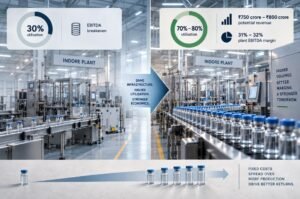
According to management’s trajectory, Indore reached around 30% utilisation and EBITDA breakeven in Q4 FY26. This was an important milestone because it suggested that production volumes had reached a level where the plant could broadly absorb its operating cost base.
The next stage is more significant.
At a mature utilisation level of around 70% to 80%, Indore has been indicated to support approximately ₹750 crore to ₹800 crore of revenue. Management has also indicated potential plant level EBITDA margins of around 31% to 32% at mature utilisation.
The difference between these two stages is substantial.
At 30% utilisation, the plant is primarily proving that it can cover its costs. At 70% to 80%, the same infrastructure can generate significantly higher revenue without requiring a proportionate increase in fixed expenses.
Automation changes the economics further
Indore was not built simply to add capacity. It was designed as a much more automated facility than Gufic’s older manufacturing infrastructure.
One comparison provided by management illustrates the difference clearly. At Navsari, packing 100,000 sterile vials can require approximately 150 people. At Indore, the same volume can reportedly be handled by only around 16 to 17 people.
This does not mean that Indore has no labour costs. Sterile manufacturing still requires highly trained technical, quality and engineering personnel.
However, automation reduces the number of people required for repetitive production and packaging activities. As volumes increase, the workforce does not necessarily need to increase at the same rate.
Higher production does not necessarily require proportionately higher labour costs. The same is true, to an extent, for the plant’s quality systems, regulatory infrastructure and manufacturing equipment.
Why the impact could become visible gradually
It is important not to assume that moving from 30% utilisation to 70% utilisation automatically means that every additional rupee of revenue becomes profit.
Raw materials, packaging materials, freight, energy consumption and certain production expenses will rise as output increases.
The first phase was capital intensive and depressed profitability because the asset had been built but was not yet fully utilised. The next phase is fundamentally different. The focus shifts from building the infrastructure to filling the available capacity.
This makes utilisation one of the most important operating indicators to track. The physical plant is already built. The next stage of the story is about how efficiently Gufic can convert that installed capacity into production, revenue and cash generation.
WHO OWNS THE MEDICINE? GUFIC’S EUROPEAN PLAY
A company can spend years developing a product, preparing regulatory data and manufacturing it to international standards, yet still capture only a relatively small portion of the final value if another company owns the rights to sell that product in a particular market.
This is where Gufic’s international strategy, centred around Gufic Ireland Limited, becomes important.
The company is gradually moving beyond a model where it simply manufactures products for overseas partners. Instead, it is increasingly trying to own the regulatory dossiers and Marketing Authorizations, allowing it to retain greater control over how those products are commercialised internationally.
What is changing?
Traditionally, an export arrangement could work in a relatively simple way.
Gufic manufactures the medicine in India and supplies it to an overseas pharmaceutical company or distributor. That partner holds the necessary local approval to sell the medicine and manages its commercialisation. This model allows a manufacturer to access international markets without building its own commercial infrastructure. However, the manufacturer has less control over the final pharmaceutical asset.
The overseas partner may control pricing, market access and distribution. If the relationship changes, the manufacturer may also have limited control over the commercial future of the product in that market.
Gufic’s newer approach attempts to change this relationship.
The role of Gufic Ireland
A Marketing Authorization, often called an MA, is essentially the regulatory approval that allows a specific medicine to be sold in a particular market.
It is linked to the product’s regulatory dossier, which contains detailed information about the medicine, including its formulation, manufacturing process, quality standards and supporting regulatory data.
Instead of allowing an overseas distributor to own this approval, Gufic is increasingly seeking to retain ownership through Gufic Ireland Limited, its wholly owned subsidiary.
This gives the company greater flexibility. It can still work with distributors, but it is no longer necessarily dependent on them to own the underlying regulatory approval.
In simple terms, Gufic is trying to move from merely being the factory behind a product to owning a larger part of the product’s commercial infrastructure.
One pharmaceutical asset, multiple ways to monetise it
Owning the dossier and Marketing Authorization creates several possible commercial routes.
The first is direct supply. Gufic can manufacture the finished product and supply it directly to overseas customers, hospitals or procurement programmes.
The second is out licensing. In markets where Gufic does not want to build its own commercial presence, it can allow another pharmaceutical company to market the product while retaining ownership of the underlying regulatory asset. The commercial partner handles sales and distribution, while Gufic can earn licensing income alongside product supply revenue, depending on the arrangement.
The third is technology transfer. In markets where local manufacturing is preferred or required, Gufic can transfer its manufacturing process and technical know-how to another manufacturer. This allows the company to monetise its development and manufacturing expertise without necessarily building another physical facility.
The key difference is that the same product is no longer tied to only one business model.
Building a presence in Europe
Gufic Ireland has secured the company’s first direct Marketing Authorization in the European Union. The company has also initiated regulatory filings across 18 European countries through the European regulatory framework.
This is significant because Europe is not simply another export destination. Regulated pharmaceutical markets generally require extensive documentation and manufacturing compliance before products can be approved.
Once a company successfully develops and registers a product, the regulatory work itself becomes an important commercial asset.
The objective is therefore not just to export more vials from India. It is to build a portfolio of products for which Gufic directly controls the regulatory rights.
The company has also indicated a partnership with a major global health organisation for one of its complex injectable assets, potentially providing access to procurement opportunities across 109 public health markets.

Such opportunities can be particularly relevant for complex injectable products because they combine Gufic’s manufacturing capabilities with a much larger international distribution opportunity.
Why this strategy fits with Indore and Navsari
Owning more regulatory assets would have limited value if the company lacked sufficient capacity to manufacture them. Conversely, building a large manufacturing facility becomes more valuable when the company has greater control over the products and markets it supplies.
Navsari’s established regulatory manufacturing infrastructure and Indore’s additional capacity could therefore support a broader portfolio of directly controlled international products over time.
The larger change in the business model
The company is gradually building capabilities across product development, sterile manufacturing, regulatory dossiers, Marketing Authorizations and international commercial partnerships.
Each of these activities sits at a different stage of the pharmaceutical value chain.
The long-term success of this strategy will depend on execution. Regulatory approvals must be obtained, products must be successfully commercialised, and international partnerships must translate into sustainable volumes.
WHERE GUFIC CHOOSES TO COMPETE: COMPLEXITY OVER VOLUME
Fertility: Building a specialised therapeutic platform
One of Gufic’s important speciality businesses is Ferticare, which focuses on infertility and Assisted Reproductive Technologies.
The IVF process requires several specialised medicines at different stages. These include hormones that stimulate egg production, medicines that control ovulation and products used to support embryo implantation.
Gufic’s portfolio includes products such as recombinant hormones, gonadotropins and other specialised fertility treatments. Products such as Puregraf, an rFSH product, and Supergraf, a uHMG product, are part of this broader fertility platform.
The company has also expanded into more specialised areas such as recurrent implantation failure, where an embryo repeatedly fails to implant despite IVF attempts. This is where products such as Guficin Alpha fit into the portfolio. Rather than being another conventional fertility hormone, this treatment is positioned around reproductive immunology.
The broader objective appears to be to build a portfolio that covers multiple stages of the fertility treatment process rather than relying on a single product.
That can be commercially important because fertility specialists may prefer working with companies that can provide several complementary therapies within the same therapeutic area.
Botulinum toxin: A very high barrier business
Gufic’s botulinum toxin platform is another example of how the company has entered a technically specialised category. Botulinum toxin is widely known for its cosmetic applications, but its medical uses are much broader. It can be used in conditions involving muscle spasticity, neurological disorders and certain chronic conditions.
Gufic markets its toxin platform through products such as Stunnox for aesthetic applications and Zarbot for therapeutic applications. The manufacturing process itself is highly specialised because botulinum toxin is an extremely potent biological substance. Producing, purifying and formulating it safely requires specialised facilities, technical expertise and strict quality controls.
The company is also attempting to broaden its aesthetic offering beyond toxin products. Through its partnership with Prollenium, Gufic is adding dermal fillers and related aesthetic products. This allows the company to participate in a broader set of treatments offered by dermatologists and aesthetic practitioners. Instead of selling only one injectable product, the objective is to build a wider aesthetic portfolio around the same customer base.
Critical care: Complexity inside the hospital
Gufic’s largest business remains connected to hospital injectables, particularly products used in critical care.
These include complex anti-infectives, antifungal medicines and specialised injectable therapies used in intensive care and tertiary hospitals.
The company has established positions in products such as Caspofungin, Micafungin and Polymyxin B, which are used in serious hospital infections.
Gufic is also attempting to differentiate itself through advanced delivery formats. One example is the Dual Chamber IV Bag.
A conventional injectable medicine may require a healthcare professional to manually mix a dry drug with a liquid before administration. In a dual chamber bag, the drug and liquid are stored separately inside a closed system and mixed immediately before use.
The objective is to reduce preparation steps and minimise the possibility of contamination or reconstitution errors. Gufic has positioned this as an important differentiated delivery platform in the Indian market.
The company has also been expanding its hospital portfolio into areas such as diagnostic contrast media and Total Parenteral Nutrition, further increasing the range of specialised products supplied to hospitals.
The manufacturing opportunity behind specialised products
These therapeutic platforms are also closely linked to manufacturing capabilities. Some of the most complex products require specialised delivery formats, including depot injections, liposomal formulations, microspheres and lyophilised injectables.
A depot injection, for example, is designed to release a medicine gradually over weeks or months. This requires more than simply filling a drug into a vial. The formulation itself must be engineered to control how quickly the medicine is released inside the body. Similarly, liposomal formulations involve enclosing a medicine within microscopic structures that can improve how the drug is delivered within the body.
These products create additional opportunities for Gufic’s contract manufacturing and development operations. The company already works as a manufacturing partner for 12 to 14 large pharmaceutical companies, particularly in areas where sterile injectable manufacturing is technically demanding.
Peptides and the move towards greater self-reliance
Another developing part of Gufic’s strategy is peptide manufacturing.
Peptides are chains of amino acids and are used in several specialised medicines, including hormonal therapies and certain biological treatments. Historically, sourcing complex peptide ingredients can involve dependence on overseas suppliers. Gufic has been developing its own peptide synthesis capabilities to increase internal supply of selected active ingredients.
This can potentially serve two purposes. First, it provides greater control over the supply chain for specialised products. Second, producing selected ingredients internally can reduce dependence on imported raw materials. Management has indicated that internal development of certain peptide ingredients has reduced the manufacturing cost index for selected products from 100 to 70.
The significance of this should not be overstated as a company-wide cost reduction. It relates to selected products. However, it illustrates the broader direction of Gufic’s strategy: controlling more of the manufacturing chain for complex products.
Some products are difficult to manufacture. Some require specialised delivery systems. Others operate in therapeutic areas where doctors need considerable clinical familiarity with the product. Many require stringent sterile manufacturing standards.
Gufic’s approach appears to be built around operating in these areas rather than competing solely in the largest and most commoditised segments of the pharmaceutical market. This does not remove competition. Speciality products can still face pricing pressure, new entrants and regulatory challenges.
The company is gradually building a combination of specialised therapeutic portfolios and complex manufacturing capabilities. Indore provides the physical capacity to manufacture more products, while the specialised businesses determine what kind of products can fill that capacity.
THE FINAL TEST: CAN GROWTH TURN INTO CASH?
By this point, the broad structure of Gufic’s business becomes clearer. The company has built additional manufacturing capacity at Indore, is expanding its presence in specialised therapeutic areas and is attempting to take greater ownership of its international pharmaceutical assets.
But ultimately, none of these developments can be evaluated through revenue growth alone.
| Financial Metric (₹ crore) | FY24 | FY25 | FY26 |
| Revenue | 806.7 | 819.8 | 940.5 |
| EBITDA | 148.1 | 138.6 | 152.9 |
| EBITDA Margin | 18.35% | 16.91% | 16.26% |
| Profit After Tax | 86.1 | 69.9 | 63.2 |
| PAT Margin | 10.67% | 8.53% | 6.72% |
The numbers show the transition Gufic is currently going through. Revenue increased meaningfully in FY26, but profitability remained under pressure as Indore was still ramping up. The most important question is whether higher production and sales eventually translate into stronger profitability, better cash generation and a healthier balance sheet. This is where the next phase of Gufic’s journey becomes particularly important.
| Cash Flow from Operating Activities (₹ crore) | FY23 | FY24 | FY25 | FY26 |
| CFO | −26.59 | −7.46 | +122.57 | +45.14 |
From capacity to earnings
The financial logic behind the company’s expansion can be viewed as a sequence.
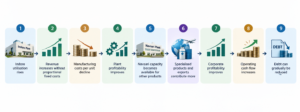 Revenue is not the same as cash
A pharmaceutical company can report strong revenue growth and accounting profits while still facing pressure on its balance sheet. The reason is working capital. Before Gufic receives cash from selling a product, money may already have been spent on raw materials, manufacturing, inventory, distribution and credit extended to customers.
If customers take a long time to pay, the company can remain cash constrained even while revenue is growing.This had become an important issue for Gufic.
The problem with direct hospital billing
Historically, the company used direct billing arrangements with hospitals and certain healthcare institutions.
The structure was relatively simple:
Gufic → Hospital or healthcare institution → Payment received later
The commercial advantage was that Gufic could interact more directly with the customer.
The disadvantage was the payment cycle.
Receivable days reportedly stretched to around 140 to 150 days or more in some cases. In practical terms, Gufic had already manufactured and supplied the medicine but had to wait several months to receive the cash.
This meant that growth required increasing amounts of money to remain locked in receivables.
As sales expanded, working capital requirements could also expand.
The shift back to a distribution-led model
During FY26, Gufic began restructuring this system and moved lower tier hospital business towards a more conventional distribution structure.
The new arrangement broadly follows this route:
Gufic
↓
C&F agent
↓
Stockist or dealer
↓
Hospital or clinic
Under this structure, Gufic does not have to directly manage the payment cycle of every hospital.
The trade channel takes on a larger part of the distribution and credit process.
This can improve cash discipline, although it may also reduce the company’s direct control over customer relationships and potentially affect the economics of distribution.
The transition also came with a short-term cost.
Management indicated that the restructuring resulted in an approximate ₹22 crore revenue adjustment across FY26 as the company cleaned up parts of the earlier channel structure.
This is an important distinction. The decision prioritised the quality and collectability of revenue rather than simply maximising reported sales.
The objective is to gradually bring receivables and debtor cycles under better control, with management indicating a movement towards approximately 120 days.
Why this matters for the Indore expansion
The working capital issue is directly connected to Indore.
As the new facility produces more products, Gufic will require additional money for raw materials, inventory and distribution.
If receivables remain stretched, higher revenue could consume a significant amount of the cash generated by the plant.
Debt and the path to deleveraging
Gufic currently carries gross debt of roughly ₹375 crore to ₹400 crore. Around ₹160 crore comprises term loans raised for the Indore facility, while the remaining ₹215 crore to ₹240 crore consists largely of working capital facilities used to fund inventory and receivables.
Management has indicated that gross debt will remain broadly capped at around ₹375 crore through FY27, with incremental working capital requirements for Indore expected to be funded through internal cash generation rather than additional borrowing.
The focus is expected to shift from funding expansion to deleveraging from FY28. As Indore utilisation moves towards 70% to 75%, management plans to allocate roughly ₹75 crore to ₹80 crore annually towards term loan prepayments, with the stated objective of bringing gross debt down towards ₹300 crore within two years and becoming substantially net debt free by FY30.
What the financial targets suggest
Management has outlined a broad financial direction for the coming years.
Revenue growth is targeted at approximately 15% to 20% annually. Consolidated EBITDA margins, which were around 16% in FY26, are expected to move towards the 18% range in FY27 as Indore utilisation improves.
Over the longer term, management has indicated an ambition for consolidated EBITDA margins to move above 20% by 2030.
Indore itself is expected to be more profitable at mature utilisation, with management indicating potential plant level EBITDA margins of 31% to 32%.
Exports are also expected to become a larger part of the business, with the company targeting an international revenue share of roughly 30% to 35% over time.
These figures provide a useful framework, but the actual outcome will depend on execution.
The most important indicators will be whether Indore utilisation continues to rise, whether margins improve as expected and whether higher profits are converted into operating cash flow.

What needs to be monitored
There are a few things that will play out in the coming few years for Gufic.
Utilisation of the Indore plant will be crucial. If this plant begins utilising commercial production incrementally, then its fixed costs can be allocated to a larger company, making it profitable. However, if its utilisation remains low, it could keep exerting pressure on the company’s finances.
International market expansion will be another area that will be very crucial. Gufic needs regulatory approvals and new customers for its international growth. Having manufacturing capacity alone is not sufficient for international revenues.
The specific specialty businesses of the company, like fertility treatments, botulinum toxin, critical care, and complex manufacturing, can also be another key issue.
Lastly, the management of working capital will decide the extent of conversion of the company’s reported growth into cash.
This company has reached a level where execution of the plans and initiatives will be as crucial as capacity addition. This company has already made investments in its manufacturing plants and product lines. The next phase will depend on how effectively it can bring all these parts together and turn them into sustainable growth.
If you need guidance on how to start your stock market journey, how much capital is enough to begin with, how to do smart investing, or how to take informed stock market decisions, you can join Strategic Alpha’s ‘The Conviction Club’. This is a membership program, especially curated to help investors become aware and knowledgeable about stock market trends, news, and technical aspects, so that they can become their own experts.
Our YouTube channel, weekly webinars, and digital resources available on the website can help you learn the basics of the stock market. For regular updates on trends, one-to-one sessions with experts, and detailed learning modules, you can join the Conviction Club, which is the online community of like-minded investors sharing knowledge and thoughts to grow together.
Subscribe to the Strategic Alpha Newsletter now to get the latest updates about weekly webinars.
Join Me On My Telegram Channel Where I Share Much More Value Adding Knowledge Of Investing/ Trading: Click Here
Also, Don’t Forget To Follow Us On Our Social Media Accounts:
Facebook: https://www.facebook.com/strategicalpha/
Instagram: https://www.instagram.com/strategicalpha/
Twitter: https://twitter.com/suyog_dhavan
YouTube: https://bit.ly/2IIqztO
Disclaimer: Strategic Alpha and Suyog Dhavan are not SEBI-registered investment advisor. The content provided is purely for educational purposes and should not be construed as financial or investment advice. Viewers are encouraged to conduct their own research or consult with a SEBI-registered professional before making any investment decisions.