Markets move in a cycle; there are times when everything is bullish and times when everything is bearish. This cycle repeats itself, but most investors fail to reap its benefits. When the market goes up, investors become overenthusiastic and allocate all their funds to earn quick profits, and fear takes over during a downtrend.
Also Read: How to Build an Evergreen Portfolio
Understanding how the market reacts, the impact of behavior on decisions, and being prepared before drastic market events helps us say ‘Bye Bye Bear Markets’, not because bear markets will not show up, but because we will be ready in advance to deal with these situations.
Bullish Market
A bullish market is a prolonged period of optimism. During a bullish market, investors are sure of earning good profits from their investments.
- Rising share prices
- Investors optimism
- Increased risk-taking ability
- Ignoring fundamental analysis
Bearish Market
When share prices decline by 20% or more, typically this situation is considered a bearish form of market.
- Adverse economic outlook and instability
- Withdrawal of funds by foreign investors
- Rigid liquidity
- Sudden government guidelines
The Effect of the Cycle of Market Emotions
The market emotions cycle plays a pivotal role in understanding the market. It confirms that investors’ psychology is predictable and they often repeat similar behaviour and mistakes.
Strong bull market emotions – Optimism, Belief, and Excitement
These emotions mark the beginning of a bull market. The market has just started to rise, everything is looking positive, some are thinking of entering the market, and some have already allocated funds.
The market peak – Euphoria
If there’s a time when investors are in maximum financial risk, that’s Euphoria. It is the peak of the market, and nobody wants to miss out. Everybody rushes in to buy stocks as they believe that it is impossible for the market to go bearish from this point.
Strong bearish emotions – Fear, Anxiety, Panic, and Depression
This is the time when the market starts to reverse. Stocks that have touched their ATHs recently have started to fall, and their prices are now continuously falling. Investors are unable to decide whether they should follow their stop-loss mark and exit or wait for the market to regain bullish momentum.
This is the phase of maximum destruction. The losses are irreversible because it takes years for stocks to retouch their ATHs.
The Role of Behaviour
Behaviour plays a dominant part if you want to remain profitable in the market. The market is a sphere of uncertainties, and more than intelligence, fear, and greed determine the fate of investors.
Be Disciplined – This is the foremost stock market investing tip: never compromise discipline.
Don’t Be Overconfident – Many people, after earning profits, believe that they have understood the market. This reflects in their decisions, as now they don’t seek professional guidance rather start being an expert, giving tips on how to invest in bull markets. So, set targets and take investment decisions accordingly.
Operating on Fear – You need to understand that the stock market will go upward and downward, no matter how strong the fundamentals of a stock are. Operating on fear and making instant decisions will make sure that you are always on the losing side, whether the market is bullish or bearish.
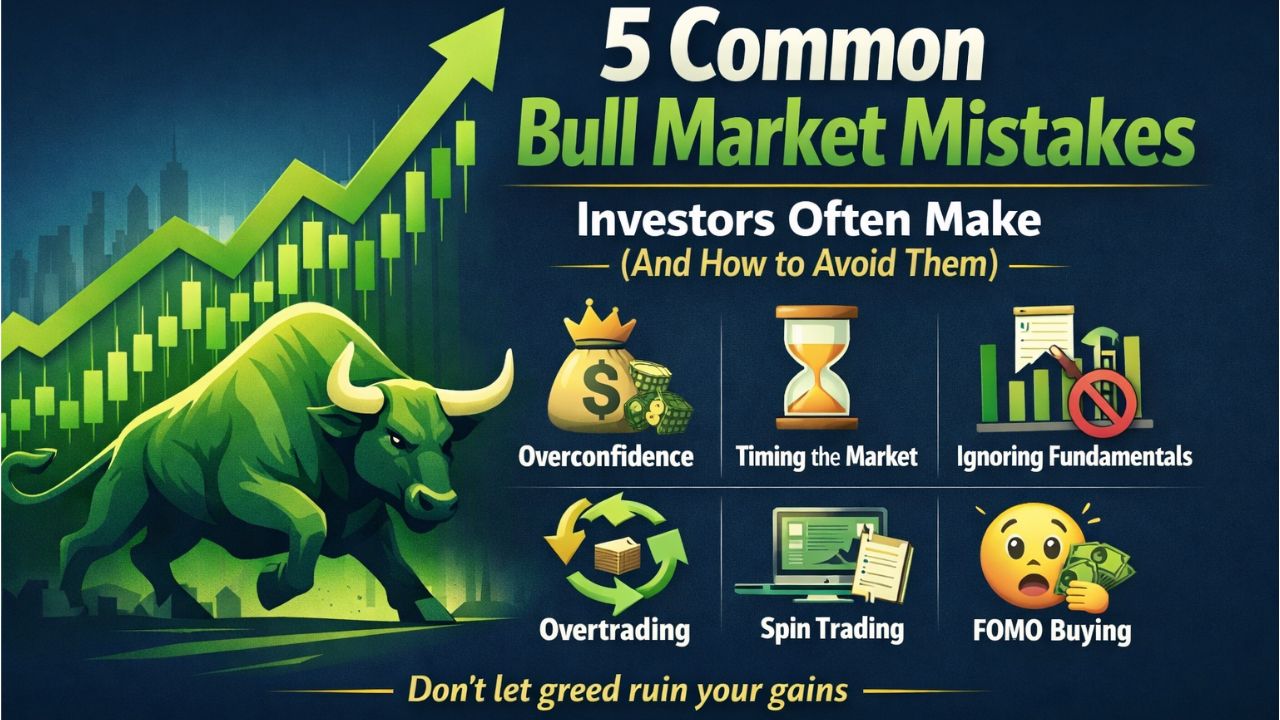
Common Mistakes to Avoid in a Bull Market
No one can guarantee profits, but one can always provide guidance on how to avoid some common mistakes that every investor makes. Understanding these mistakes will help safeguard your capital.
Believing that bull markets will never end – The most drastic end to bull markets has always come after a wild peak. Overenthusiasm of investors results in losses. Always remember the market doesn’t move in a fixed pattern; there will be bullish and bearish days. So, follow strategies, not trends.
Selling stocks at the wrong time – People often sell stocks when they are at their ATHs, believing that there is no scope for growth after this. These are the stocks that have the highest growth potential. Thus, never sell stocks at the wrong time, research thoroughly, analyze fundamentals and growth potential, and then decide.
Staying fully invested – The most common mistake to avoid in a bull market is to remain fully invested. If you have not maintained a cash buffer with you, then you won’t be able to invest when the market goes down. So, never remain fully invested and always maintain a cash buffer.
Confusing returns with skills – If there is a bullish run, even the weak stocks will get you good profits. Don’t confuse these returns with investment skills.
Strategies to Navigate a Bear Market
Knowledge of both bullish and bearish markets is essential if you want to safeguard your capital. You don’t need to be an expert in the subject matter; you just need to follow time-tested strategies that have worked for others.
Here are some strategies that will help you navigate a bear market –
- Nothing lasts forever, neither bull nor bearish. Always remember, there will be a point at which the bearish market will bounce back and regain bullish momentum. You just need to have patience and time your entry into the market accordingly.
- Don’t follow trends or naysayers if you have invested after analyzing the fundamentals and growth roadmap of the company. During bearish markets, strong stock prices also fell, but that shouldn’t be the driving factor. Focus on the quality the business provides rather than making decisions irrationally or emotionally.
- Use your buffer cash strategically; don’t go all-in when the market falls. Always buy stocks in phases when there is a bearish momentum.
Say Bye Bye to Bear Markets
Saying bye-bye to bear markets means avoiding potential risk and not repeating common mistakes that other investors make. Be optimistic but operate on rationality; don’t let your emotions drive your investment decisions.
Most investors fail not because of the bullish or bearish market but because they haven’t strategized on how to invest in the market by remaining neutral. If you are in the market for quick wealth accumulation, only luck can help you, but if you are here for long-term gains, join Strategic Alpha’s ‘The Conviction Club’.
The Conviction Club is a membership program where we discuss investment strategies, risk mitigation, and one-to-one sessions so that it’s easy for you to broadly understand how the stock market functions.
For more details, visit our profile and register yourself.
If you need guidance on how to start your stock market journey, how much capital is enough to begin with, how to do smart investing, or how to take informed stock market decisions, you can join Strategic Alpha’s ‘The Conviction Club’. This is a membership program, especially curated to help investors become aware and knowledgeable about stock market trends, news, and technical aspects, so that they can become their own experts.
Our YouTube channel, weekly webinars, and digital resources available on the website can help you learn the basics of the stock market. For regular updates on trends, one-to-one sessions with experts, and detailed learning modules, you can join the Conviction Club, which is the online community of like-minded investors sharing knowledge and thoughts to grow together.
Subscribe to the Strategic Alpha Newsletter now to get the latest updates about weekly webinars.
Join Me On My Telegram Channel Where I Share Much More Value Adding Knowledge Of Investing/ Trading: Click Here
Also, Don’t Forget To Follow Us On Our Social Media Accounts:
Facebook: https://www.facebook.com/strategicalpha/
Instagram: https://www.instagram.com/strategicalpha/
Twitter: https://twitter.com/suyog_dhavan
YouTube: https://bit.ly/2IIqztO
Disclaimer: Strategic Alpha and Suyog Dhavan are not SEBI-registered investment advisor. The content provided is purely for educational purposes and should not be construed as financial or investment advice. Viewers are encouraged to conduct their own research or consult with a SEBI-registered professional before making any investment decisions.