
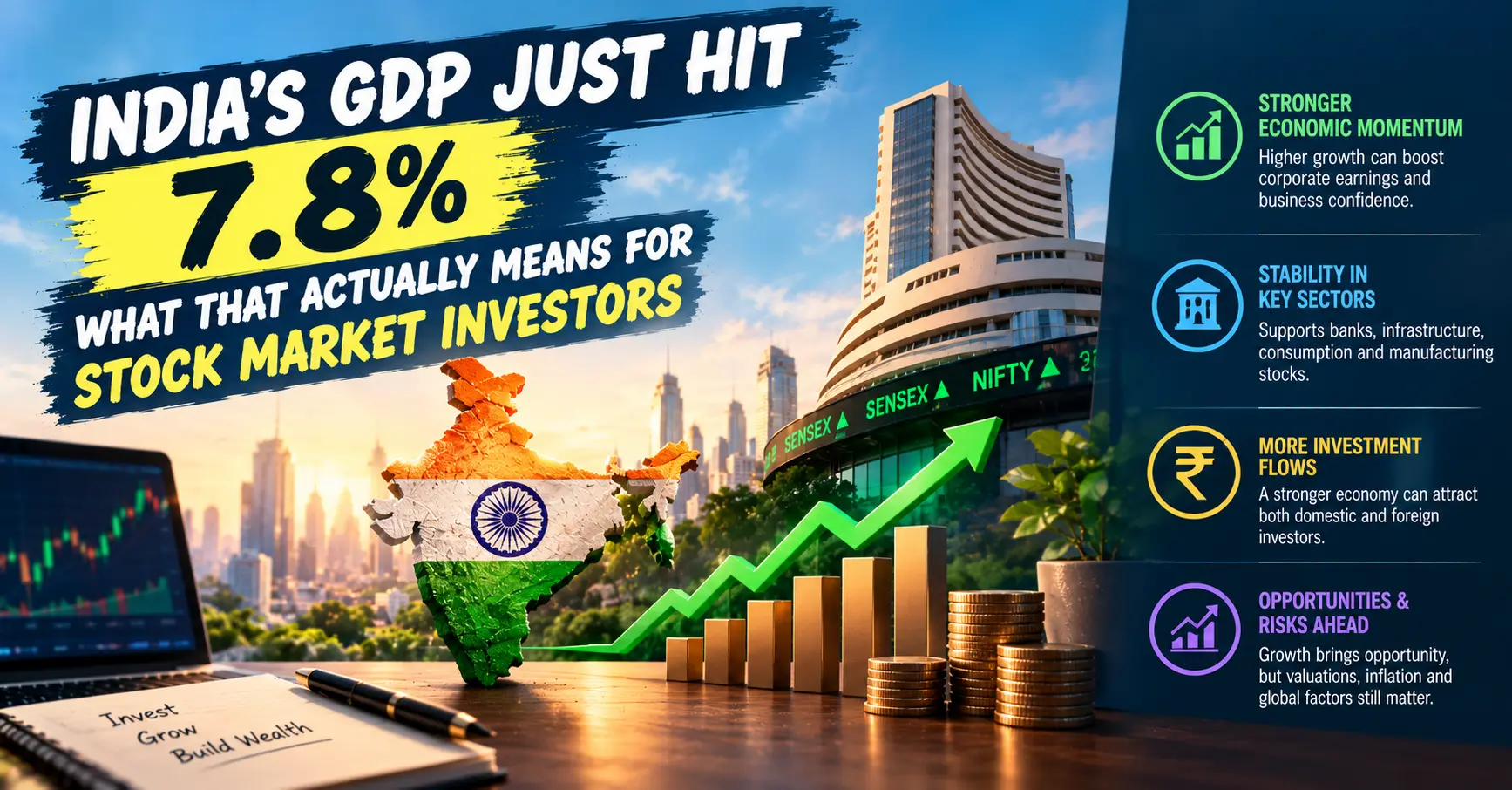
India’s economic growth was measured at 7.8% on a year-on-year basis during the April-June quarter of FY2026-27, according to the MoSPI. The estimated real GDP for the quarter stood at ₹81.36 lakh crore compared to ₹75.46 lakh crore during the corresponding quarter a year before.
What needs to be considered by stock market investors is not just whether 7.8% is a good figure or not. What they need to know is the factors responsible for such growth and how far this will contribute to company profits.
Strong GDP Growth Is Positive, But It Is Not a Buy Signal
A growing economy provides a good opportunity for businesses. Economic activity may increase demand for goods and services, encourage investments, and promote employment and incomes.
However, economic growth does not necessarily guarantee that stock prices will go up. The stock market is always looking ahead. If investors have been expecting economic growth, firms might find it difficult to provide an additional return on investment due to their high valuation.
That is why investors should not only focus on the GDP figure.
Manufacturing and Investment Are Important Signals
One of the more positive developments in the GDP numbers has been the contribution of investment and manufacturing. According to Reuters, investment and manufacturing strength helped offset poor performance in mining and consumer-focused services sectors in the April-June period.
Why is it important?
This is important because an extended investment cycle may present opportunities in many market areas. Firms associated with industrial output, capital goods, infrastructure, power, electronics, engineering, and manufacturing could prosper if companies start to expand their capacities.
What should you be looking for?
You should be looking for companies that see the benefits of economic expansion reflected in their sales and profitability.
Which Sectors Could Benefit?
The strength of the local economy could positively affect several industries; however, the effect would not be the same across the board.
Financial Services/Banking
The strength of the economy could lead to increased demand for corporate lending or other financial services. However, one still needs to look at issues such as asset quality and cost of funds.
Capital Goods
Manufacturers of industrial solutions, machinery and equipment stand to gain from increased capital spending.
Consumer Industries
Stronger economies and consumption levels could positively affect manufacturers of discretionary goods such as cars and consumer goods.
Infrastructure and Energy
Long-term investment in infrastructure and industrial capacity could lead to a long-term increase in demand for construction, engineering, energy, and related activities.
Technology and Digital
Despite being affected by international demand and competition, India’s digital economy is expected to keep on growing.
What About the Nifty 50?
The GDP figure would be a useful support factor for the overall market environment; however, investors should not presume that all companies in the Nifty 50 index are going to be positively affected.
Big firms might already incorporate optimistic growth into their price ratios, while smaller companies with emerging business opportunities would have more potential for future growth, although at a riskier stage.
Earnings growth becomes a crucial issue. In case of continued GDP growth and no similar improvement in corporate earnings, the stock market might not be able to reflect the economic reality.
Investors Should Watch Earnings, Not Just GDP
The best way to use the 7.8% GDP number is to regard it positively on the macroeconomic level, not necessarily as an investment signal.
Investors need to observe whether the positive activity will continue driving up revenues for companies, profits, cash flow, and sustainable capital expenditure. Investors have to take into account the valuations since a fundamentally good company could still disappoint with its performance if the stock price was too high.
There are risks as well. According to Moody’s, high energy prices and possibly higher food prices could pose risks for India’s inflation, consumption, and growth outlooks. Nevertheless, the agency raised its forecast for FY2027 growth to 7%.
Final Thoughts
The 7.8% GDP growth rate in India is certainly a positive sign in the sense that it means the economy is growing well with the help of investments and manufacturing sectors. But for equity markets, the real game is to know which firms are making sustainable profits out of that growth.
GDP reflects the performance of the economy. Corporate earnings reflect how well the business is making profits from this economy. And for an investor, both are much more important than just looking at the GDP growth rate.
FAQs
Does a higher GDP always mean stock markets will go up?
A higher GDP may increase demand for goods and services, encourage investments, and promote employment and incomes, but it does not guarantee that stock markets will go up.
Which sectors benefit the most when India’s GDP grows at 7.8%?
Sectors associated with industrial output, capital goods, infrastructure, power, electronics, engineering, and manufacturing could prosper.
Why is India’s stock market falling even when GDP growth is strong?
India’s stock market can go down even when there is high GDP growth due to factors like companies’ profitability, valuation, interest rates, international markets, foreign investment, and economic risk factors. High GDP growth is a good thing, but it doesn’t mean that stock prices will increase.
How does India’s 7.8% GDP growth compare to other emerging markets?
India’s GDP growth of 7.8% is high compared with most of the major emerging economies. It proves that India continues to be one of the fastest-growing economies. But GDP growth itself doesn’t decide how the market will perform.
If you need guidance on how to start your stock market journey, how much capital is enough to begin with, how to do smart investing, or how to take informed stock market decisions, you can join Strategic Alpha’s ‘The Conviction Club’. This is a membership program, especially curated to help investors become aware and knowledgeable about stock market trends, news, and technical aspects, so that they can become their own experts.
Our YouTube channel, weekly webinars, and digital resources available on the website can help you learn the basics of the stock market. For regular updates on trends, one-to-one sessions with experts, and detailed learning modules, you can join the Conviction Club, which is the online community of like-minded investors sharing knowledge and thoughts to grow together.
Subscribe to the Strategic Alpha Newsletter now to get the latest updates about weekly webinars.
Join Me On My Telegram Channel Where I Share Much More Value Adding Knowledge Of Investing/ Trading: Click Here
Also, Don’t Forget To Follow Us On Our Social Media Accounts:
Facebook: https://www.facebook.com/strategicalpha/
Instagram: https://www.instagram.com/strategicalpha/
Twitter: https://twitter.com/suyog_dhavan
YouTube: https://bit.ly/2IIqztO
Disclaimer: Strategic Alpha and Suyog Dhavan are not SEBI-registered investment advisor. The content provided is purely for educational purposes and should not be construed as financial or investment advice. Viewers are encouraged to conduct their own research or consult with a SEBI-registered professional before making any investment decisions.