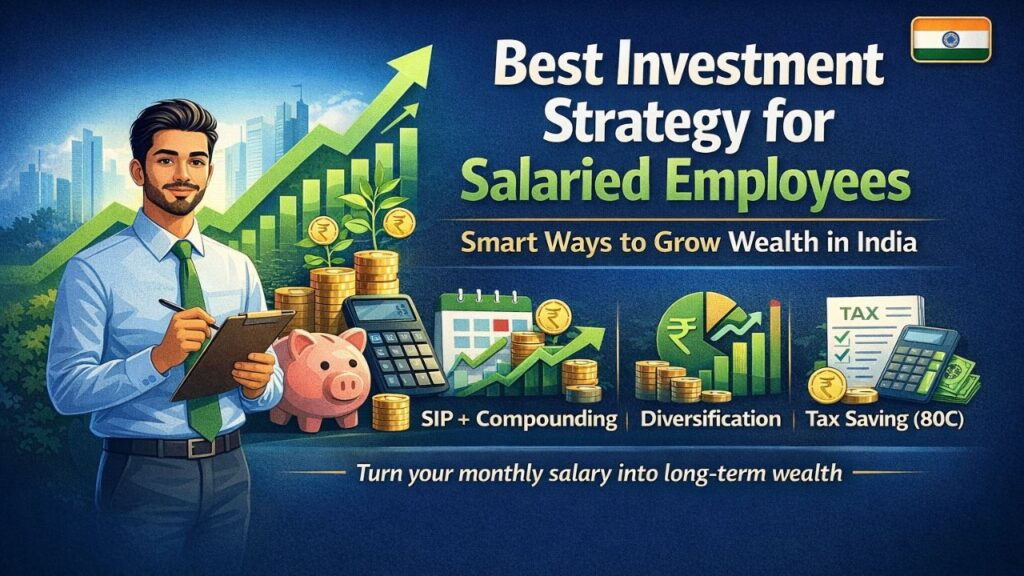
Unlike business owners, salaried employees rely on a fixed income. Having multiple sources of income is one of the most essential skills that every salaried employee should know. This will help them in maintaining liquidity in critical situations, tackle financial emergencies, retire early, and spend on leisure activities or hobbies.
Therefore, the stock market becomes one of the most suitable options for salaried employees for a second income stream. Although the stock market appears simple from the outside, and people believe it is easy to earn profits, that’s not true.
You need to have a deep understanding of the market.
Understanding of how trends and news affect the market.
You should have a rational approach.
A clear investment strategy.
This will help mitigate potential risks, safeguard your capital, and enhance the utility of your salaried income.
Why Salaried Employees Need Strong Stock Market Investment Strategies
Salaried employees operate on a fixed income and, unlike business owners, salaried employees usually have a lower risk appetite, therefore, salaried employees need to make the best out of their investment.
Therefore, to achieve investment goals, it is necessary to have a strong stock market investment strategy. Before investing in the stock market, you should outline your investment goals, such as:
- Do you want to buy a house?
- Are you planning to retire early?
- Are you investing to have enough money during your child’s higher education?
- Are you investing in building an emergency fund?
These powerful questions will make selecting the best stock market investment strategy easier and help you move forward with a clear mind.
What You Should Do
To make your stock market investment journey easier, here are some of the time-tested investment strategies that you can follow as a salaried employee.
Salary Allocation
Divide your salary into three parts:
- One Part for Needs
- One Part for Lifestyle
- One Part for Investment
For a feasible salary allocation, you can follow the 50:30:20 rule, 50% of your salary for needs, 30% for lifestyle, and 20% for investment and savings.
It might be tough initially, but with time, it will fit into your subconscious mind that you can use only 80% of your salary for needs and wants.
Emergency Fund
During the initial years of your investment journey, you should create an emergency fund to overcome unexpected events. The stock market is not a lake that can be sailed smoothly; it is a sea full of waves, and you should be ready to accept that. We have seen many events like the 2008 recession, the COVID-19 pandemic, and the current ongoing war between Iran, Israel, and the USA.
Today, while this article was being written, the stock market crashed nearly 20%, and that’s a huge dip.
Therefore, keeping an emergency fund aside will help you stay afloat during unforeseen circumstances.
Invest In Pension Schemes, Mutual Funds, and SIPs
While investing in the stock market, make sure to allocate funds in pension schemes, mutual funds, and SIPs. As stock market investment returns are uncertain, during bull runs, you might make 50% on your allocated capital, but you can also lose money during a bear market.
Therefore, these other financial assets may not give unimaginable returns, but will surely increase your capital.
Diversification
As we have discussed above, diversification is necessary to cope with negative market trends. Invest in multiple financial assets or invest in stocks of multiple sectors, so if one sector doesn’t perform up to expectations, the other does.
Gradual Increase In Investment
Never start investing with a huge sum of money if you don’t have in-depth knowledge of the stock market. It is true that you don’t need to be an expert to invest in the stock market, but you can not deny the fact that some basic understanding or knowledge is important. If you are a salaried employee, gradually increase the investment amount when you have understood how the market operates, why it is necessary to avoid emotion-based decisions, and learned to avoid common investment mistakes.
Avoiding Common Investment Mistakes
It is important to have a strong investment strategy, but it is also essential to learn from the mistakes of other investors. Here are some common investment mistakes that you should avoid:
- Investing without clear goals
- Not maintaining an emergency fund
- Chasing quick profits
- Trying to time the market
- Not researching properly
- Not rebalancing the portfolio
- Having unrealistic expectations
These mistakes can hamper your progress in the market and lead to losses. Therefore, stick to your investment strategy and make sure that the frequency of mistakes is minimal.
Final Thoughts
As a salaried person, you already have the limitation of funds to invest in the stock market, and that is why following a correct investment idea or strategy becomes so crucial. Unlike business owners, the margin of error for a salaried employee is extremely low.
If you are starting your journey as an investor, you can do your own research to learn stock market basics, or to save time and energy, you can join Strategic Alpha’s “The Conviction Club”. This is a membership program for like-minded people who are interested in making it big in the stock market, not by fluke but by a holistic understanding of the market.
FAQs
1. What is the best investment strategy for salaried employees in India?
The best investment strategy for salaried employees is to start early, follow the 50:30:20 rule, maintain an emergency fund, and diversify their investments.
2. How much salary should be invested in the stock market?
Ideally, salary should be invested in a 50:30:20 ratio; 50% for needs, 30% for lifestyle, and the remaining 20% for investment. It also depends on the individual, like if someone is not taking care of a family, they can allocate more funds.
3. How can salaried employees build long-term wealth?
For building long-term wealth, salaried employees should start early and stick to their investment strategies. To build long-term wealth in the stock market, it is important that you follow time-tested investment strategies and avoid common investment mistakes.
4. How can salaried employees start investing with a small amount?
If you are starting to invest with at least Rs 15000 initially, it will be enough to gain good experience of the market. You can gradually increase capital with time, once you learn the basics of the market and have an understanding of how the stock market operates.
5. What are the safest investment options for salaried employees in India?
The safest options are fixed-return financial assets like pension schemes, mutual funds, and SIPs. These financial assets will make sure that you earn returns from the invested money.
If you need guidance on how to start your stock market journey, how much capital is enough to begin with, how to do smart investing, or how to take informed stock market decisions, you can join Strategic Alpha’s ‘The Conviction Club’. This is a membership program, especially curated to help investors become aware and knowledgeable about stock market trends, news, and technical aspects, so that they can become their own experts.
Our YouTube channel, weekly webinars, and digital resources available on the website can help you learn the basics of the stock market. For regular updates on trends, one-to-one sessions with experts, and detailed learning modules, you can join the Conviction Club, which is the online community of like-minded investors sharing knowledge and thoughts to grow together.
Subscribe to the Strategic Alpha Newsletter now to get the latest updates about weekly webinars.
Join Me On My Telegram Channel Where I Share Much More Value Adding Knowledge Of Investing/ Trading: Click Here
Also, Don’t Forget To Follow Us On Our Social Media Accounts:
Facebook: https://www.facebook.com/strategicalpha/
Instagram: https://www.instagram.com/strategicalpha/
Twitter: https://twitter.com/suyog_dhavan
YouTube: https://bit.ly/2IIqztO
Disclaimer: Strategic Alpha and Suyog Dhavan are not SEBI-registered investment advisor. The content provided is purely for educational purposes and should not be construed as financial or investment advice. Viewers are encouraged to conduct their own research or consult with a SEBI-registered professional before making any investment decisions.