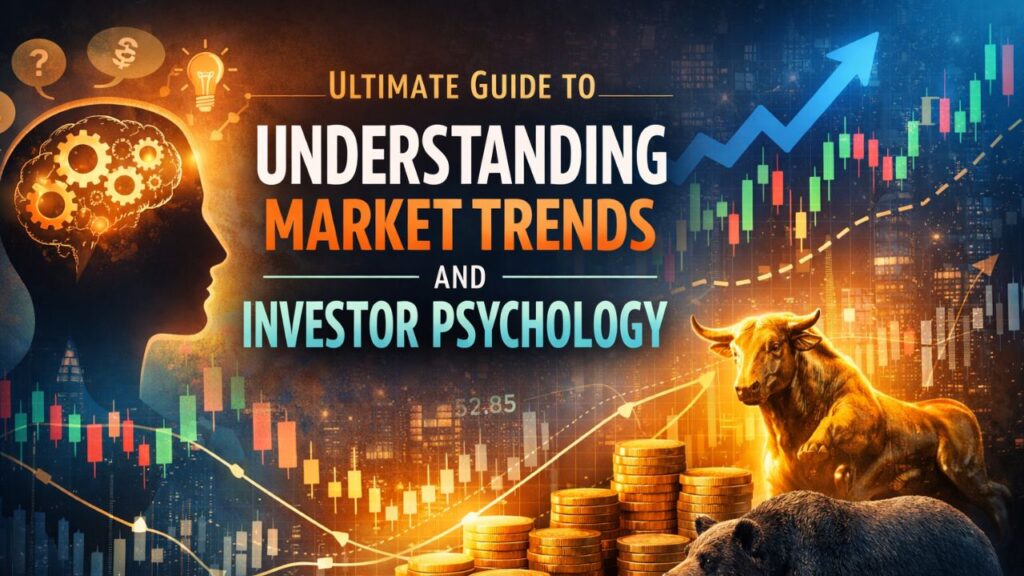
Emotions move markets. While fundamentals, earnings, and vision are important, they are often overshadowed by investor sentiment and a herd mentality.
Understanding stock market trends helps avoid the effect of sudden market movements that are not based on a company’s financial performance, but rather on fear, greed, and assumptions.
Whether facing a market crash, bearish movement, or bullish trends, only those who followed time-tested strategies and remained logical in their approach were able to succeed.
To know more about strategies that will help minimize risk and remain profitable in the stock market, read our blog, ‘Top 10 Time-Tested Investment Strategies Every Investor Should Know’.
Also Read: Psychology of A Market Cycle
What Are Market Trends?
If the stock market goes up for several days, it’s a bullish trend.
If the market is down, it’s a bearish trend.
And, if the market remains in a range, it is called range-bound.
Therefore, the direction in which the price of assets moves is known as the market trend. Identifying these trends, investors time the market, manage, or rebuild their stock portfolio.
During a bullish or uptrend, investors remain confident and their risk appetite increases, resulting in high capital investment in the market. A bubble is created in the market during a bullish trend as the fundamentals of stocks are ignored.
In a bearish trend, fundamentals are overshadowed by fear, triggering panic selling.
The Importance Of Understanding Market Trends
Understanding market trends becomes essential to reap maximum benefits under any circumstances. Although market trends may not play a substantial role for long-term investments, analyzing trends is crucial for portfolio restructuring and timing the market.
Here’s how
- Aligning investment strategy with market direction
- Avoiding the risk of buying at a higher price
- Thoughtful entry and exit from a share
- Averaging when sensing an uptrend during a bearish market
Investor Psychology
If market direction were only influenced by rationality, there would have been minimal losses, but that’s not the case. Before investing, everyone somehow knows to make decisions based on a company’s structure, performance, and other fundamentals, but ends up being influenced by fear, greed, overconfidence, hype, and regret.
More than rationality, emotions play a key role in influencing investment decisions. That is why it is extremely important to analyze one’s decision-making during the peak of these emotions and to understand what went right or wrong. This will help in placing logic before emotional bias.
The Role of Fear and Greed
Of all emotions, fear and greed take the front seat, resulting in major setbacks.
Fear – Fear comes during a bearish trend. Panic selling is at its peak, and logic and rationality fade. We have witnessed it many times during market crashes that even the price of blue-chip stocks dips.
Greed – Greed shows its dominance during market peaks. Stock prices touch higher highs and higher lows. There is an inevitable optimism in the market.
This is a time when an investor should be patient and avoid investing because we have seen many times that when the bubble bursts after the peak, it takes several months for stocks to retouch their ATHs.
Market Cycle’s Influence On Investors’ Psychology
Optimism – Rising stock prices send a signal to investors that it is the best time to enter the market.
Excitement – A sense of excitement in the market as everyone wants to quickly allocate funds in stocks. Optimism is at its peak during the excitement phase.
Euphoria – Fundamentals are ignored, negative news is overshadowed by confirmation bias, and rationality fades.
Anxiety – Market starts to correct itself, stock prices suddenly dip despite concrete reasons, and panic begins to set in.
Panic – The beginning of herd mentality is confirmed by panic. There is irrational selling in the market, prices continue to dip, and thus, more selling takes place.
Despair – The last wave of optimism goes into oblivion. Most investors have suffered losses on their stocks and feel there is no recovery from this point.
Hope – Stock prices begin to rebound from their lows, a bullish trend takes charge, and a shift from irrational buying to cautious buying is seen.
Rationality and Patience Win
Whether a bullish or bearish trend, only those who have been rational, patient, and avoided herd mentality have survived adversities.
Investors who avoided buying during the ‘Euphoria’ phase and saved their capital to invest during market recovery are the ones who are profitable.
We should understand that the stock market will always move in a positive direction with time, and everyone knows it. Therefore, buying and selling decisions should be taken with sincerity. Like, if you buy a stock in optimism at the wrong time, you would have to wait for years for the stock price to rebound. Although there are high chances that you’ll still become profitable at some point in time, but if the decision was made rationally, your money would not have been trapped in a particular stock for years.
Final Thoughts
The stock market is a combination of economics and human emotions. You should remain aware to safeguard your capital and minimize risks. Be a smart investor who not only analyzes fundamentals but also follows market trends rigorously. A mixed strategy will help you invest in good stocks and time the market perfectly.
FAQs
- What are the market trends in the stock market?
The direction in which the stock market goes is considered the market trend; it can be bullish or bearish.
- Why do market trends matter to investors?
Understanding trends helps make rational decisions, that is, avoiding buying at highs so that the funds can be utilized when the market starts to rebound or can be used in portfolio rebuilding.
- What is investor psychology?
Decisions based on emotional biases, under the influence of fear and greed, perfectly explain investor psychology.
- What tools are used to analyze trends?
Tools like RSI, MACD, and fundamental analysis can be used to analyze market trends. These tools will provide an overview of whether the stock is overbought or oversold, if it is bullish or bearish, etc.
- How can beginners manage emotions while investing?
To send emotions to the back seat while investing, beginners must analyze whether their goals align with their decisions or not. They should also stop chasing short-term profits or market movements and focus on the bigger picture.
Our YouTube channel, weekly webinars, and digital resources available on the website can help you learn the basics of the stock market. For regular updates on trends, one-to-one sessions with experts, and detailed learning modules, you can join the Conviction Club, which is the online community of like-minded investors sharing knowledge and thoughts to grow together.
Subscribe to the Strategic Alpha Newsletter now to get the latest updates about weekly webinars.
Join Me On My Telegram Channel Where I Share Much More Value Adding Knowledge Of Investing/ Trading: Click Here
Also, Don’t Forget To Follow Us On Our Social Media Accounts:
Facebook: https://www.facebook.com/strategicalpha/
Instagram: https://www.instagram.com/strategicalpha/
Twitter: https://twitter.com/suyog_dhavan
YouTube: https://bit.ly/2IIqztO
Disclaimer: Strategic Alpha and Suyog Dhavan are not SEBI-registered investment advisor. The content provided is purely for educational purposes and should not be construed as financial or investment advice. Viewers are encouraged to conduct their own research or consult with a SEBI-registered professional before making any investment decisions.